Design and Evaluation of an Innovative Curriculum to Achieve Diversity, Equity, and Inclusion in Iran’s Higher Education System
DOI:
https://doi.org/10.61838/jsied.485Keywords:
Innovative curriculum, diversity, equality, inclusion, higher education, Iranian education system, curriculum design, curriculumAbstract
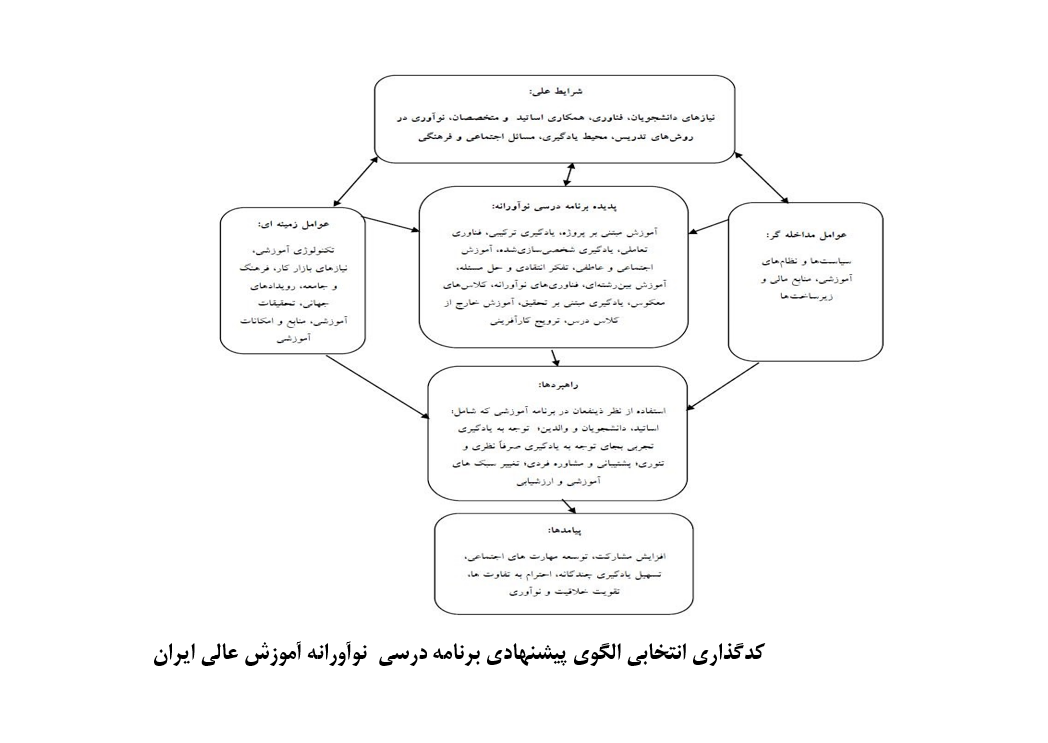
The aim of this study was to design and evaluate an innovative curriculum based on diversity, equity, and inclusion principles to promote a more inclusive and equitable higher education system in Iran. This qualitative study employed the systematic grounded theory approach of Strauss and Corbin. Participants included curriculum experts, faculty members, educational managers, and higher education specialists selected through purposive and theoretical sampling until theoretical saturation was achieved. Data were collected via in-depth structured interviews, document analysis, and literature review. Data analysis was conducted through open, axial, and selective coding using NVivo software. To evaluate the extracted model, a researcher-developed questionnaire with confirmed validity and reliability was administered to experts . The findings indicated that the innovative curriculum comprises twelve key components, with project-based learning showing a significantly higher priority compared to other components, whereas innovative technologies and flipped classrooms ranked significantly lower. Significant relationships were identified among causal, contextual, and intervening factors influencing curriculum strategies, leading to outcomes such as increased participation, enhanced social skills, and improved creativity. Results also demonstrated that alignment with student needs and labor market demands significantly contributes to achieving diversity, equity, and inclusion . An innovative curriculum grounded in diversity, equity, and inclusion can enhance educational justice and quality in higher education through active learning approaches, stakeholder engagement, and effective use of educational technologies.
Downloads
References
1. Gupta A. Focus on Quality in Higher Education in India. Indian Journal of Public Administration. 2021;67(1):54-70. doi: 10.1177/00195561211007224.
2. Li Y, Zhang X, Dai DY, Hu W. Curriculum Innovation in Times of the COVID-19 Pandemic: The Thinking-Based Instruction Theory and Its Application. Frontiers in Psychology. 2021;12(3):601-17. doi: 10.3389/fpsyg.2021.601607.
3. Mohammadi R, Soleimani A. Systematic Review of Educational Justice in Iran: Conceptualization, Challenges and Indicators. Educational Planning Studies. 2023;12(23):145-70. doi: 10.22080/eps.2024.26091.2220.
4. Setiabudi DI, Ismi SF. Analysis of the Alignment of OBE-Based Curriculum With the Principles of Sustainable Development Goals in Higher Education. Icgel. 2025;2(1):46-58. doi: 10.62951/icgel.v2i1.147.
5. Ministry of Science W. Ministry of Science Website. 2024.
6. Omidvar A, Niazi M, Mazrouei Nasrabadi I, Khodakarmian Gilan N. Future Study of the Employment Status of Graduates of Humanities in Iran: A Product-Oriented View Using the Causal Layer Analysis Method. Quarterly Journal of Interdisciplinary Studies in the Humanities. 2014;16(1):121-56. doi: 10.22035/isih.2024.4975.4829.
7. Jafari H. Iranian Economy and Maritimeism. Journal of Modern Studies in Economic Diplomacy. 2023;12(3):25-55.
8. Mosali S, Amini A, Garai-Nejad G, Khosravinejad A. The Effect of Quality and Quantity of Human Capital in the Type of Education on Total Factor Productivity in the Non-Oil Economy of Iran. Quarterly Journal of Computational Economics. 2022;1(1):25-50.
9. Wu YJ, Chen JC. Stimulating Innovation with an Innovative Curriculum: A Curriculum Design for a Course on New Product Development. The International Journal of Management Education. 2021;19(3):100561. doi: 10.1016/j.ijme.2021.100561.
10. Irawati D, Najili H, Supiana S, Zaqiah QY. Merdeka Belajar Curriculum Innovation and Its Application in Education Units. Edumaspul: Jurnal Pendidikan. 2022;6(2):2506-14. doi: 10.62775/edukasia.v4i2.507.
11. Dano M, Prado N. Innovative Curriculum Design, Classroom Management Strategies, Competencies, and Mathematics Teachers' Performance: A Causal Model. Psychology and Education: A Multidisciplinary Journal. 2024;27(2):199-203.
12. Supriani Y, Meliani F, Supriyadi A, Supiana S, Zaqiah QY. The Process of Curriculum Innovation: Dimensions, Models, Stages, and Affecting Factors. Nazhruna: Jurnal Pendidikan Islam. 2022;5(2):485-500. doi: 10.31538/nzh.v5i2.2235.
13. Senivongse C, Bennet A. University-as-a-Service: Designing Thinking Approach for Bangkok University Business Innovation Curriculum and Service Development. Innovations in Education and Teaching International. 2024;61(5):1101-24. doi: 10.1080/14703297.2023.2253251.
14. Hosseini Largani SM. Designing an Innovative Curriculum Model in the Iranian Higher Education System: A Qualitative Study. Quarterly Journal of Research and Planning in Higher Education. 2022;25(3):27-49.
15. Jafarpour M, Hashemi SA, Mashinchi AA. Design and Validation of an Entrepreneurial Curriculum Model in Secondary Schools in Line with the General Policies of the System's Entrepreneurship. Strategic and Macro Policies. 2024;12(45):48-86.
16. Nasirian A, Ghiyashi Nadushan S, Khorsandi Taskoveh A, Taheri M, Kamali Y. Designing a Model for Evaluating the Final Impact of Policy in Iranian Higher Education. Public Policy. 2023;9(3):9-25.
17. Mousavi S, Abbasi Z, Izadi L, Ghasemi M, Safari R. Evaluation of Privatization Policies of Public Higher Education: A Case Study of Iranian Higher Education. Quarterly Journal of Research and Planning in Higher Education. 2024;31(1):77-113.
18. Rad T. Application of Iranian Basic Texts in Teaching Political Science with Emphasis on Kalileh and Demne. Political Science. 2023;19(2):395-418.
19. Sobhani Nejad M, Khalafi M. Studying the Compatibility of the Curriculum Content of In-Service Training Courses with Job Descriptions from the Perspective of the Staff of the Technical and Vocational Education Organization During 2019. Education Journal. 2019;3(1):23-49. doi: 10.1016/j.heliyon.2021.e06995.
20. Asgarova V, Hashmi ZF, Ngajie BN, Asghar MZ, Järvenoja H. Exploring Faculty Experiences With Generative Artificial Intelligence Tools Integration in Second Language Curricula in Chinese Higher Education. Discov Computing. 2025;28(1). doi: 10.1007/s10791-025-09655-6.
21. Zheng S. Artificial Intelligence – Driven Design of Aesthetic Education Curricula in Higher Education. Educ Insights. 2025;2(6):247-56. doi: 10.70088/ta9v8365.
22. Strauss A, Corbin J. Basics of Qualitative Research: Techniques and Procedures for Developing Grounded Theory: Sage Publications; 1998.
23. Behboodi Golkhatami A, Taghizadeh H, Bafandeh Zendeh A. Human Resources Planning Model of Mehr Eqtesad Bank Using System Dynamics. Public Policy Making in Management. 2021;12(1):83-96.
24. Ahmadi Moqim A, Sukhdari K. Identifying the Framework of Entrepreneurship Education Curriculum Elements for Secondary Schools and Free Technical and Vocational Schools Using the Meta-Synthesis Method. Skill Training. 2022;10(38):118-52.
25. Salari M, Momeni Mahmoui H, Akbari A, Zirak M. Designing a Model for Making Higher Education Textbooks and Curricula Agile: A Case Study of Islamic Azad University. Research and Writing of Academic Textbooks. 2019;27(53):205-35. doi: 10.30487/rwab.2024.2014814.1589.
26. Ajdari Fam N, Farajollahi M, Sarmadi MR, Mahboubi T. Design and Validation of a Learning-Based Curriculum Model with Emphasis on the Aker Model in Higher Education. Bi-Quarterly Journal of Higher Education Curriculum Studies. 2020;11(21):251-90. doi: 10.61838/kman.ijes.7.1.17.
27. Abdollahi F, Ranjdoust S, Yarigholi B. Designing and Validating an Optimal Transformation Model in Humanities with Emphasis on Curriculum in the Higher Education System of the Islamic Republic of Iran. Journal of Applied Educational Leadership. 2025;1:1-20.
28. Dixon K. Accounting for higher education: Calculative practices in curricular administration. Critical Perspectives on Accounting. 2025;102(11):102805-30.
Downloads
Publication Timeline
- Submitted
- Revised
- Accepted
Issue
Section
License
Copyright (c) 2025 Ali Radmehr, Fatemeh Shefaat, Farzaneh Soufi (Author); Roghayeh Khademi (Corresponding author)

This work is licensed under a Creative Commons Attribution-NonCommercial 4.0 International License.