A Comparison of Attribution Types among Secondary School Students with Academic Failure in Mathematics
DOI:
https://doi.org/10.61838/jsied.488Keywords:
Documentary aspects, academic failure, effort, circumstances, talent, luck, level of difficultyAbstract
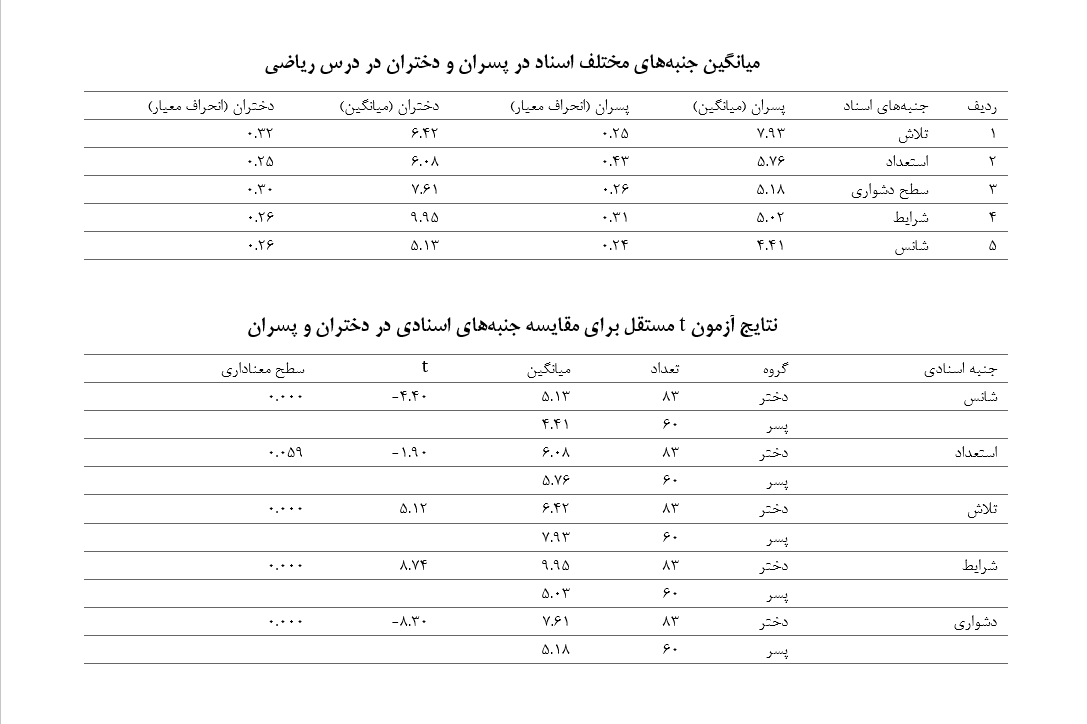
The present study aimed to compare attributional styles among male and female secondary school students with academic failure in mathematics and to examine differences in the dimensions of effort, ability, conditions, luck, and task difficulty. This study employed a non-experimental causal-comparative design. The statistical population consisted of male and female second-grade high school students in Behbahan City studying in mathematics and experimental sciences who experienced academic failure in mathematics. The sample included 143 students (83 females and 60 males) selected through census sampling. Students with scores below 10 in mathematics during the first academic term of the 2025–2026 academic year were included. Data were collected using the Mathematics Attribution Questionnaire, which consisted of 17 four-point items assessing five attribution dimensions: effort, ability, luck, conditions, and task difficulty. The questionnaire demonstrated a Cronbach’s alpha reliability coefficient of 0.83. Descriptive statistics and independent samples t-tests were used for data analysis. The findings indicated that both male and female students used all attribution dimensions to explain their academic failure in mathematics. Among male students, effort obtained the highest mean score, whereas among female students, environmental conditions and task difficulty showed the highest means. Independent samples t-test results revealed significant gender differences in effort, conditions, luck, and task difficulty (P<0.001), while no significant difference was observed in the ability dimension (P>0.05). The findings further demonstrated that male students relied more on internal attributions, whereas female students relied more on external attributions to explain their mathematics failure. The findings suggest that attributional styles play a significant role in explaining academic failure in mathematics. Male students’ attribution of failure to effort may promote responsibility and motivation for academic improvement, whereas female students’ attribution to environmental conditions and task difficulty may contribute to reduced motivation and learned helplessness. Therefore, modifying maladaptive attributional styles and strengthening internal and controllable attributions may help reduce mathematics academic failure among secondary school students.
Downloads
References
1. Seif AA. Educational Psychology. Tehran: Agah Publications; 2021.
2. Santrock J. Educational Psychology. Omidian M, editor. Yazd: Yazd University; 2006.
3. Karimi Y. Social Psychology: Theories, Concepts, and Applications. 45th ed: Arasbaran Publications; 2024.
4. Carabeo JN, Tado PP. Student's Self-Esteem and Self-Control as Predictors of Academic Achievement of Students in Mathematics. Epra International Journal of Research & Development (Ijrd). 2024:149-55. doi: 10.36713/epra17796.
5. Steinberg O, Kulakow S, Raufelder D. Academic self-concept, achievement, and goal orientations in different learning environments. European Journal of Psychology of Education. 2024. doi: 10.1007/s10212-024-00825-6.
6. Baseri M. The relationship between mathematical self-efficacy and academic self-regulation with mathematics achievement of ninth-grade male students in Kamfirouz schools in the 2022-2023 academic year: Islamic Azad University, Marvdasht Branch; 2024.
7. Soleimani Far M. Investigating the Role of Attitude, Self-Efficacy, and Mathematical Self-Concept in Improving Mathematical Educational Performance. Modern Research in Performance Evaluation. 2025;4(2):124-38.
8. Schoenherr J, Schukajlow S, Pekrun R. Emotions in Mathematics Learning: A Systematic Review and Meta-Analysis. ZDM - Mathematics Education. 2025;57:603-20.
9. Gomez-Talal I, Bote-Curiel L, Rojo-Alvarez JL. Understanding the Disparities in Mathematics Performance: An Interpretability-Based Examination. Engineering Applications of Artificial Intelligence. 2024;133(Part B):108109. doi: 10.1016/j.engappai.2024.108109.
10. Darmanova Z, Abylkassymova A, Nurmukhamedova Z. A Systematic Review of Technology Use in Middle and High School Mathematics Education: Insights from Contextual, Methodological, and Evaluation Characteristics. Frontiers in Education. 2025;10. doi: 10.3389/feduc.2025.1644284.
11. Darmayanti R. Programmed Learning in Mathematics Education Before and After the Pandemic: Academics Integrate Technology. Alj. 2024;2(1):40-56. doi: 10.61650/alj.v2i1.126.
12. Heidari S, Taghvaei D, editors. The effectiveness of using an educational platform on academic motivation and academic achievement in mathematics among female junior high school students: A case study of Skyroom. Proceedings of the First National Conference on Research and Studies in Psychology and Educational Sciences (Mental Health in the Digital Age); 2025.
13. Zhu L, You H, Minju, Fang F. Predictive Insights into U.S. Students' Mathematics Performance on PISA 2022 Using Ensemble Tree-Based Machine Learning Models. International Journal of Educational Research. 2025;130(5):102537. doi: 10.1016/j.ijer.2025.102537.
14. Babaei A, editor A Comparative Study of Attribution Types among Male and Female Students with Academic Failure in Arabic Course at Lower Secondary Level. Proceedings of the Fifth National Conference on Pedagogical Content Knowledge (PCK) in Arabic Language and Literature Education; 2025 2025/12: Farhangian University.
15. Granello F, Cuder A, Doz E, Pellizzoni S, Passolunghi MC. Improving Math Self-Efficacy and Math Self-Concept in Middle School: A Narrative Systematic Review. European Journal of Psychology of Education. 2025.
Downloads
Publication Timeline
- Submitted
- Revised
- Accepted
Issue
Section
License
Copyright (c) 2025 Ali Babaei (Corresponding author)

This work is licensed under a Creative Commons Attribution-NonCommercial 4.0 International License.