The Relationship between Teachers’ Digital Technology Skills and Educational Media Literacy with Technology Integration in Teaching in Elementary Schools of Jam City
Keywords:
Digital Technology Skills, Educational Media Literacy, Technology Integration in Teaching, Elementary School Teachers, Jam CityAbstract
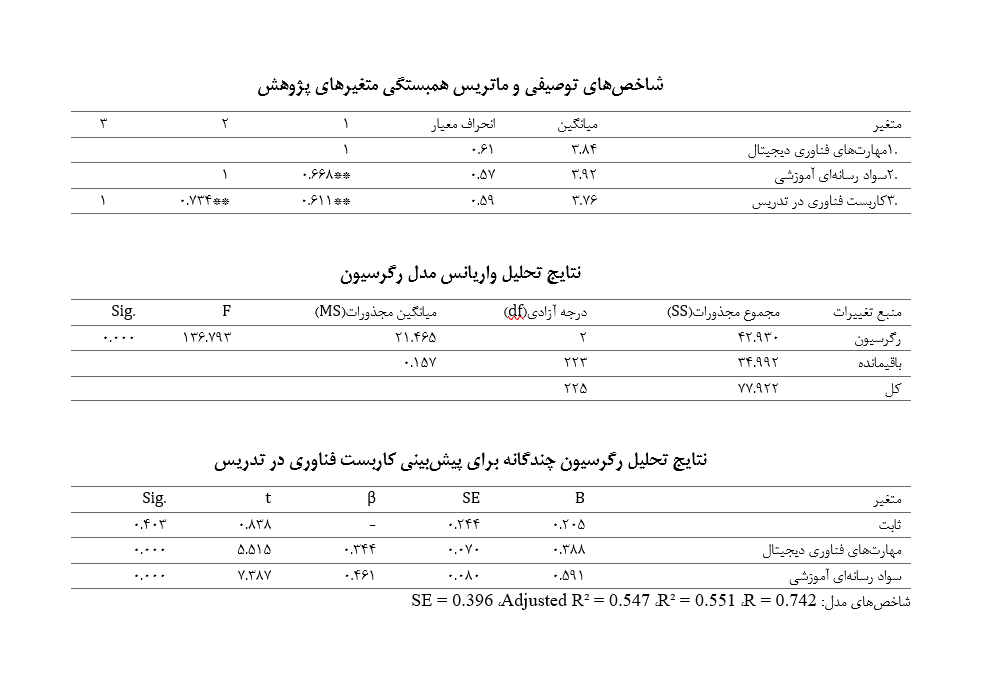
This study aimed to examine the relationship between teachers’ digital technology skills and educational media literacy with technology integration in teaching among elementary school teachers in Jam City. This applied study used a descriptive-correlational design. The statistical population included all elementary school teachers in Jam City during the 2025–2026 academic year (N=550), from whom 226 teachers were selected using Cochran’s formula and simple random sampling. Data were collected using standardized questionnaires measuring teachers’ digital technology skills, educational media literacy, and technology integration in teaching. The validity of the instruments was confirmed by expert judgment, and their reliability had been established in previous studies. Data were analyzed using SPSS version 26 through the Kolmogorov–Smirnov test, Spearman correlation coefficient, and multiple regression analysis. The results indicated a significant positive relationship between digital technology skills and technology integration in teaching (r=0.611, p<0.001). Educational media literacy was also positively and significantly related to technology integration in teaching (r=0.734, p<0.001). Moreover, a significant positive relationship was found between digital technology skills and educational media literacy (r=0.668, p<0.001). Multiple regression analysis showed that digital technology skills and educational media literacy jointly explained 55.1% of the variance in technology integration in teaching (R²=0.551, F=136.793, p<0.001). Educational media literacy (β=0.461, p<0.001) was a stronger predictor than digital technology skills (β=0.344, p<0.001). The findings suggest that improving teachers’ digital technology skills, particularly their educational media literacy, can enhance technology integration in teaching. Accordingly, professional development programs focused on these competencies may contribute to improving teaching and learning quality in elementary schools.
Downloads
References
1. Organisation for Economic C-o, Development. Education at a Glance 2020: OECD Indicators. OECD Publishing, 2020.
2. Unesco. ICT Competency Framework for Teachers (ICT CFT), Version 3. UNESCO, 2018.
3. Pilgrim J, Vasinda S, Lisenbee PS. Integrating Technology in Literacy Instruction: Models and Frameworks for All Learners. 2nd ed: Routledge; 2025.
4. Prate J, Kong J, Hoque L, Sugita T, Belom T. A Meta-Analysis of Technology Usage in Word Problem Solving Interventions for Elementary Students: An Application of the SAMR Model. Research and Practice in Technology Enhanced Learning. 2026;21:001. doi: 10.58459/rptel.2026.21001.
5. Wang H, Yu S, Lv B, Ma Z, editors. Construction of Smart Campus in Primary and Secondary Schools Based on Teachers' Needs: Taking the Dongcheng District of Beijing as an Example. Proceedings of the 2023 2nd International Conference on Educational Innovation and Multimedia Technology (EIMT 2023); 2023.
6. Zarghi M, Hosseini Jonbazdi SA, editors. Technology and Tomorrow's Schools: Smart Schools. National Conference on Interdisciplinary Research in Management and Humanities; 2023.
7. Ertmer PA, Ottenbreit Leftwich AT. Removing Obstacles to the Pedagogical Changes Required by Jonassen's Vision of Authentic Technology Enabled Learning. Computers & Education. 2013;64:175-82. doi: 10.1016/j.compedu.2012.10.008.
8. Tondeur J, Pareja Roblin N, van Braak J, Voogt J, Prestridge S. Preparing Beginning Teachers for Technology Integration in Education: Ready for Take Off? Technology, Pedagogy and Education. 2017;26(2):157-77. doi: 10.1080/1475939X.2016.1193556.
9. Jung YJ, Cho K, Shin WS. Revisiting Critical Factors on Teachers' Technology Integration: The Differences between Elementary and Secondary Teachers. Asia Pacific Journal of Education. 2019;39(4):548-61. doi: 10.1080/02188791.2019.1620683.
10. Timotheus R, Lepp M. How and Why Teachers Use Technology: Distinct Integration Practices in K-12 Education. Education Sciences. 2024;14(12):1301. doi: 10.3390/educsci14121301.
11. Redecker C, Punie Y. European Framework for the Digital Competence of Educators: DigCompEdu. Publications Office of the European Union, 2017.
12. Spante M, Hashemi SS, Lundin M, Algers A. Digital Competence and Digital Literacy in Higher Education Research: A Systematic Review. Education and Information Technologies. 2018;23:1-23. doi: 10.1080/2331186X.2018.1519143.
13. Yurdakul C, Demir K. Technology Integration in Pedagogical Processes: Digital Competence and Teaching Practices of Primary School Teachers in Turkey. Discover Education. 2025;4:Article 351. doi: 10.1007/s44217-025-00646-9.
14. Pinto M, Leite C. Digital Technologies in Primary Schools: A Systematic Review of Teacher Acceptance and Adoption Models. Education and Information Technologies. 2025.
15. Rahimi S, Rezaei M. Information Literacy and Perceived Usefulness of Personalized Learning Technologies among Primary Teachers. Journal of Computer Assisted Learning. 2025;41(2):1-18.
16. Abebe F, Trainin G. Predicting Technological, Pedagogical, and Content Knowledge (TPACK) Formation in Elementary Math Education. Contemporary Issues in Technology and Teacher Education. 2024;24(2). doi: 10.70725/521250nwdsyh.
17. Ga S, Cha H, Yoon H. Pre-Service Elementary Teachers' Technological Pedagogical and Content Knowledge in Lesson Planning and Post-Lesson Reflection Discourses on Science Classes Using Virtual and Augmented Reality Content. Journal of Science Education and Technology. 2025;34:171-82. doi: 10.1007/s10956-024-10171-3.
18. Hobbs R. Digital and Media Literacy: Connecting Culture and Classroom: Corwin Press; 2011.
19. Buckingham D. The Media Education Manifesto: Polity Press; 2019.
20. Unesco. Media and Information Literate Citizens: Think Critically, Click Wisely! Curriculum for Teachers and Learners. UNESCO, 2021.
21. Puentedura RR. SAMR: A Contextualized Introduction. Hippasus, 2014.
22. Syukran R, Adriansyah A, Alimir IJ, Syafitri W, Sesmiarni Z, Bayu EPS. Exploring Teachers' Experiences in Integrating SAMR-Based Adaptive Technology in Primary English Reading-Writing Instruction. El-Rusyd. 2025;10(2):330-8. doi: 10.58485/elrusyd.v10i2.535.
23. Liu Y, Pásztor A. Exploring the Digital Divide in Primary Education: A Comparative Study of Urban and Rural Mathematics Teachers' TPACK and Attitudes towards Technology Integration in Post-Pandemic China. Education and Information Technologies. 2025;30(2):1913-45. doi: 10.1007/s10639-024-12890-x.
24. Ursavas ÖF, Karal H. Modelling Primary School Teachers' Acceptance of Distance-Based Educational Technologies: A Post-Pandemic Perspective. Education and Information Technologies. 2024;29(13):16499-523. doi: 10.1007/s10639-024-12509-1.
25. Matsepane JR, Mampane MR. ICT Integration in a Multigrade Context: Exploring Primary School Teachers' Experiences. Research in Social Sciences and Technology. 2024;9(1):232-52. doi: 10.46303/ressat.2024.13.
26. Tan L, Thomson R, Koh JHL, Chik A. Teaching Multimodal Literacies with Digital Technologies and Augmented Reality: A Cluster Analysis of Australian Teachers' TPACK. Sustainability. 2023;15(13):10190. doi: 10.3390/su151310190.
27. Abbaszadeh M, Azizi N, Emamgholizadeh N, editors. The Necessity of Familiarizing Educators and Educational Specialists with Media Literacy and Emerging Technologies. First International Conference on New Horizons in Learning Psychology and Education from the Teacher's Perspective; 2025; Urmia.
28. Sarfarazi S, Payam BA, Nosrati E, Nosrati E, editors. The Role of Teachers' Digital Literacy in Improving the Quality of E-Learning in Smart Schools. Second National Conference on Humanities with a New Approach and First International Research Conference of Modern Educators; 2025; Astara.
29. Jalilian A, editor Investigating Elementary Teachers' Digital Literacy and Its Effect on the Quality of Technology-Based Teaching. First International Conference on Artificial Intelligence in Education, Psychology, Educational Sciences, and Religious, Cultural, Social, and Management Studies in the Third Millennium; 2025; Bushehr.
30. Rezaei M, Ahmadi A, Bagheri M. Identifying the Components of Smart Schools Based on a Constructivist Approach. Development of Education in Jundishapur. 2020;11(Special Issue):115-27.
31. Alirezanajad M, Sabeti Choubdar L, editors. An Introduction to the Application of Information and Communication Technology in Today's Organizations. Seventh National Conference on Management and E-Commerce; 2023; Tehran.
32. Mashhadi H. A Comparative Study of the Curricula of Selected Countries with Emphasis on Developing Information and Communication Technology Literacy among Student Teachers. Curriculum Studies. 2022;17(64):95-124.
33. Taghvaei Yazdi M, Golafshani A, Aghamirzaei Mahalli T, Aghatabar Roudbari J, Yousefi Saeedabadi R. Investigating the Status of Information and Communication Technology Use and Its Effect on Faculty Members' Performance. Research in Medical Education. 2019;11(2):64-73.
34. van Laar E, van Deursen AJAM, van Dijk JAGM, de Haan J. Determinants of 21st-Century Skills and 21st-Century Digital Skills for Workers: A Systematic Literature Review. Sage Open. 2020;10(1). doi: 10.1177/2158244019900176.
Downloads
Publication Timeline
- Submitted
- Revised
- Accepted
Issue
Section
License
Copyright (c) 2025 Nooshafarin Safari, Parvane Dodman, Bayram Aghapour, Sadegheh Solemani (Author)

This work is licensed under a Creative Commons Attribution-NonCommercial 4.0 International License.