تأثیر الگوی تدریس سوادحرکتیمحور بر بهبود مهارتهای بنیادی، خودتنظیمی در تمرین و مشارکت فعال دانشآموزان در درس تربیتبدنی: نقش واسطهای بازخورد آموزشی معلم
کلمات کلیدی:
سواد حرکتی, مهارتهای حرکتی بنیادی, خودتنظیمی تمرین, بازخورد آموزشی, مشارکت فعال دانشآموزچکیده
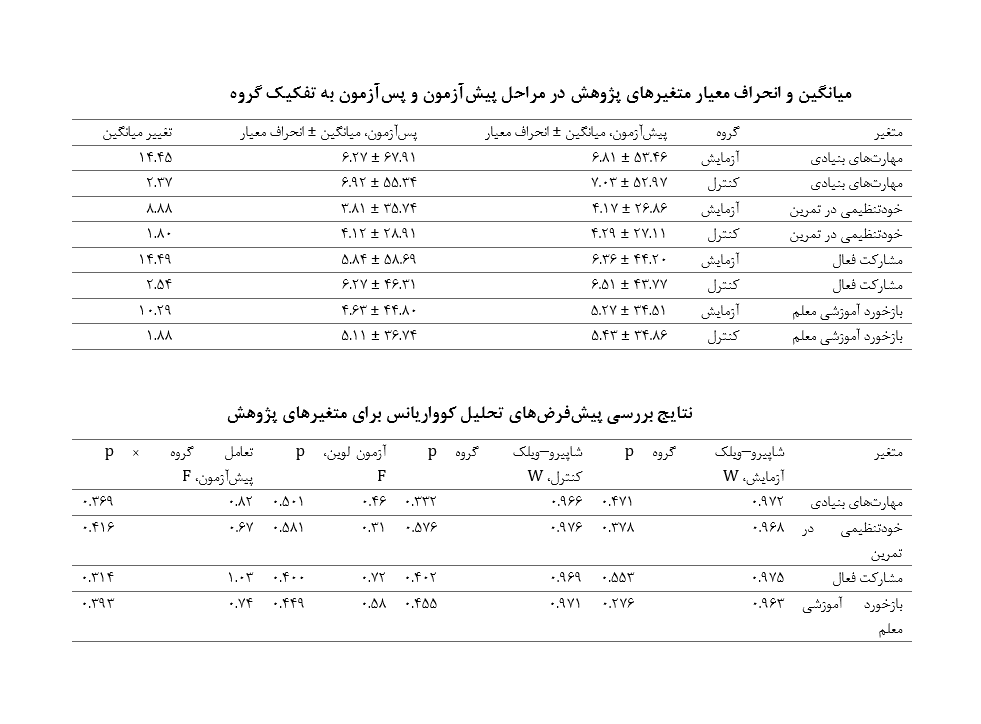
هدف پژوهش حاضر بررسی تأثیر الگوی تدریس سوادحرکتیمحور بر مهارتهای بنیادی، خودتنظیمی در تمرین و مشارکت فعال دانشآموزان در درس تربیتبدنی با تأکید بر نقش واسطهای بازخورد آموزشی معلم بود. پژوهش حاضر نیمهآزمایشی با طرح پیشآزمون–پسآزمون و گروه کنترل بود. جامعه آماری شامل دانشآموزان دختر پایههای چهارم تا ششم ابتدایی منطقه ۲ آموزشوپرورش شهر تهران در سال تحصیلی ۱۴۰۳–۱۴۰۴ بود که ۷۰ نفر با روش نمونهگیری تصادفی خوشهای انتخاب و بهطور مساوی در گروه آزمایش و کنترل قرار گرفتند. گروه آزمایش طی ۱۶ جلسه ۴۵ دقیقهای، دو جلسه در هفته، آموزش مبتنی بر سواد حرکتی را دریافت کرد. ابزارها شامل آزمون مهارتهای حرکتی درشت ویرایش سوم، پرسشنامه خودتنظیمی در تمرین، مقیاس مشارکت فعال دانشآموز و مقیاس بازخورد آموزشی معلم بود. دادهها با تحلیل کوواریانس و تحلیل میانجیگری مبتنی بر بوتاسترپ ۵۰۰۰ بازنمونهای تحلیل شدند. نتایج تحلیل کوواریانس نشان داد اثر گروه بر مهارتهای بنیادی معنادار بود (F=97.86، p<0.001، η²p=0.594). همچنین، اثر مداخله بر خودتنظیمی در تمرین (F=72.88، p<0.001، η²p=0.521)، مشارکت فعال (F=89.39، p<0.001، η²p=0.572) و بازخورد آموزشی معلم (F=60.04، p<0.001، η²p=0.473) معنادار بود. تحلیل میانجیگری نیز نشان داد بازخورد آموزشی معلم اثر مداخله بر مهارتهای بنیادی با اثر غیرمستقیم 0.256، خودتنظیمی در تمرین با اثر غیرمستقیم 0.306 و مشارکت فعال با اثر غیرمستقیم 0.335 را بهطور معناداری میانجیگری کرد. با توجه به معنادار باقیماندن اثرهای مستقیم، میانجیگری در هر سه مدل از نوع جزئی بود. الگوی تدریس سوادحرکتیمحور میتواند با تقویت همزمان مهارتهای حرکتی، خودتنظیمی و مشارکت فعال دانشآموزان، کیفیت یادگیری در درس تربیتبدنی را ارتقا دهد و بخشی از این اثر از طریق بهبود بازخورد آموزشی معلم منتقل میشود؛ بنابراین، ادغام بازخوردهای وظیفهای، فرایندی و خودتنظیمی در برنامههای سواد حرکتی میتواند رویکردی مؤثر برای آموزش تربیتبدنی دوره ابتدایی باشد.
دانلودها
مراجع
1. Valle-Muñoz VM, Mendoza-Muñoz M, Villa‐González E. Physical Literacy as a Pedagogical Model in Physical Education. Children. 2025;12(8):1008. doi: 10.3390/children12081008.
2. Grauduszus M, Koch L, Wessely S, Joisten C. School-Based Promotion of Physical Literacy: A Scoping Review. Frontiers in Public Health. 2024;12. doi: 10.3389/fpubh.2024.1322075.
3. Hill PJ, McNarry MA, Mackintosh KA, Murray MA, Pesce C, Valentini N, et al. The Influence of Motor Competence on Broader Aspects of Health: A Systematic Review of the Longitudinal Associations Between Motor Competence and Cognitive and Social-Emotional Outcomes. Sports Medicine. 2023;54(2):375-427. doi: 10.1007/s40279-023-01939-5.
4. He R. The Relationship Between Motor Skills and Social Development in 6–12 years Old Typically Developing Children: A Systematic Review. Frontiers in Psychology. 2026;17. doi: 10.3389/fpsyg.2026.1845725.
5. Butler L, Gupta A, DeVerna A, Moore JG, Latz K, Davelaar CMF, et al. Physical Literacy in Elementary Physical Education: A Survey of Fundamental Movement Skill Practice Patterns. Pediatric Physical Therapy. 2021;34(1):56-61. doi: 10.1097/pep.0000000000000843.
6. Eyre ELJ, Adeyemi LJ, Cook K, Noon M, Tallis J, Duncan M. Barriers and Facilitators to Physical Activity and FMS in Children Living in Deprived Areas in the UK: Qualitative Study. International Journal of Environmental Research and Public Health. 2022;19(3):1717. doi: 10.3390/ijerph19031717.
7. Tocci N, Scibinetti P, Mazzoli E, Mavilidi MF, Masci I, Schmidt M, et al. Giving Ideas Some Legs or Legs Some Ideas? Children’s Motor Creativity Is Enhanced by Physical Activity Enrichment: Direct and Mediated Paths. Frontiers in Psychology. 2022;13. doi: 10.3389/fpsyg.2022.806065.
8. Tao X, Zhang J, Wang X, Guo M. Development of a Physical Literacy Assessment Framework for Chinese Preschool Children: A Delphi–AHP Approach. Frontiers in Public Health. 2025;13. doi: 10.3389/fpubh.2025.1650793.
9. Fluency and Reading Comprehension in Typical Readers and Dyslexic Readers, Volume II. 2024. doi: 10.3389/978-2-8325-4580-5.
10. Trabelsi O, Gharbi A, Souissi MA, Mezghanni N, Bouchiba M, Mrayeh M. Video Modeling Examples Are Effective Tools for Self-Regulated Learning in Physical Education: Students Learn Through Repeated Viewing, Self-Talk, and Mental Rehearsal. European Physical Education Review. 2021;28(2):341-60. doi: 10.1177/1356336x211046300.
11. Talaghir L-G, Olaru BS, Ciorbă C, Rus CM, Iconomescu TM. A Knowledge-Based Approach to Physical Education: A Systematic Review. Revista Romaneasca Pentru Educatie Multidimensionala. 2023;15(4):252-78. doi: 10.18662/rrem/15.4/792.
12. Chou MH. Language Mindsets and Strategic Approaches to Studying: The Mediating Roles of Control‐Value Appraisals and Emotions. Psychology in the Schools. 2024;62(3):765-77. doi: 10.1002/pits.23353.
13. Li Z, Xiao Y. Unpacking the Influence of Teachers' Reading Instruction Strategies on Primary School Students' Reading Achievement: Evidence From PIRLS 2021. Reading Research Quarterly. 2025;60(4). doi: 10.1002/rrq.70064.
14. Miao M, Chai H, Xue R, Qi W. Effects of Perceived Variety-Support on Middle School Students’ Learning Engagement in Physical Education: The Mediating Role of Motivation. Frontiers in Psychology. 2024;15. doi: 10.3389/fpsyg.2024.1459362.
15. Calmeiro L, Paupério T, McCabe JJC, Teques P. Students’ Perceptions of Teaching Styles Use and Motivation to Participate in PE: A Multigroup Analysis of the Mediating Role of Basic Psychological Needs. European Physical Education Review. 2025;31(4):713-30. doi: 10.1177/1356336x241309756.
16. Tian F, Li F. Teaching Styles and Sports Engagement: Mediation by Satisfaction and Resilience in Chinese Adolescents. Frontiers in Psychology. 2025;16. doi: 10.3389/fpsyg.2025.1630300.
17. Monacis D, Annoscia S, Limone P, Colella D. Examining the Effects of Reproductive and Productive Teaching Styles Interventions on Primary Schoolchildren. What Implications for Physical Education Teachers? Physical Education Theory and Methodology. 2023;23(6):839-49. doi: 10.17309/tmfv.2023.6.05.
18. Monacis D, Annoscia S, Limone P, Colella D. Examine the Effects of a Reproduction and Production Teaching Styles Interventions in Primary Schoolchildren. What Implications for Physical Education Teachers? 2023. doi: 10.20944/preprints202309.1595.v1.
19. Zha H, Ding X, Li W. Innovative Approaches in Physical Education: Leveraging Cognitive Activation to Boost Student Outcomes. Frontiers in Psychology. 2025;16. doi: 10.3389/fpsyg.2025.1481381.
20. Ghorbel A, Trabelsi O, Yaakoubi M, Gharbi A. Flipped Classroom Approach for Gymnastics Learning in Physical Education: A Quasi-Experimental Study. International Journal of Sports Science & Coaching. 2024;20(1):300-12. doi: 10.1177/17479541241301382.
21. Liu K, Hao Z, Chen J, Wu Q, Jin W, Pan Y, et al. Impact of Flipped Classroom Instruction on Brain-Mediated Motor Skill Performance in University Students: A Systematic Review and Meta-Analysis. Brain Sciences. 2025;15(5):501. doi: 10.3390/brainsci15050501.
22. Ferraz R, Ribeiro D, Alves AR, Teixeira JE, Forte P, Branquinho L. Using Gamification in Teaching Physical Education: A Survey Review. Montenegrin Journal of Sports Science and Medicine. 2024;13(1):31-44. doi: 10.26773/mjssm.240304.
23. Luptáková G, Argajová J, Balga T, Augustovičová D, Sobotová P, Balint G, et al. Team Teaching Models in Primary Physical Education: Effects on Basic Motor Competencies and Self-Reported Physical Literacy. Children. 2025;12(12):1595. doi: 10.3390/children12121595.
24. Wilkie B, Cáceres P, Marchena JM, Jordan A. Is the Development of Physical Literacy Ubiquitous in High-Quality Physical Education? European Physical Education Review. 2023;30(1):36-50. doi: 10.1177/1356336x231179344.
25. Müller JK, Wagner I. Formative Assessment of Motor Learning Through Digital Tools in Physical Education: A Systematic Literature Review. European Physical Education Review. 2025;32(2):383-403. doi: 10.1177/1356336x251357207.
26. Chai H. Digital Transformation in Physical Education: A Bibliometric Analysis of Global Trends, Hotspots, and Future Directions Through CiteSpace. Sage Open. 2025;15(4). doi: 10.1177/21582440251395582.
27. Zhao B, Chen J, Su Y. Digital Empowerment for Innovative Teaching: Application and Mediating Effects of Information Technology in Physical Education Teachers’ Practices. Frontiers in Sports and Active Living. 2025;7. doi: 10.3389/fspor.2025.1612745.
28. Qiaoli X, Bing L. How University Physical Education Instructors’ Political Literacy Shapes Student Values: The Mediating Role of Teacher Educative Efficacy in the Chinese Context. Frontiers in Psychology. 2026;17. doi: 10.3389/fpsyg.2026.1782929.
29. Jin H. Gen AI Literacy and Acceptance Among EFL Teachers: An Exploration Through The UTAUT Model and Self‐Determination Theory. European Journal of Education. 2025;61(1). doi: 10.1111/ejed.70364.
30. Zhu G, Dai X, Jiang S, Wang Z, Liang M, Pan Y, et al. Generative AI in Physical Education and Health: A Narrative Review and Conceptual Framework for Interdisciplinary Thematic Learning. Frontiers in Public Health. 2026;14. doi: 10.3389/fpubh.2026.1842782.
31. Daly A. Artificial Intelligence in Education: Effects on Motor Learning, Motivation, and Student Engagement From an Educational Psychology Perspective. Frontiers in Psychology. 2026;17. doi: 10.3389/fpsyg.2026.1816494.
32. Kwon Y, Park JW, Cho G, Kim D, Kang M, Yang D. High-Tech, High-Touch Physical Education: Drone Soccer as a Sustainable Sport Activity for Sport-Marginalized Students. Frontiers in Psychology. 2026;17. doi: 10.3389/fpsyg.2026.1787499.
33. Espinar MC, Hernández AL. Beyond Written-Linguistic Modes of Meanings: Multimodal Representations to Extend the Range of Literacy Learning in EMI Students. Journal of Language Teaching and Research. 2023;14(1):6-19. doi: 10.17507/jltr.1401.02.
34. International Society of Research and Advocacy for Developmental Coordination Disorder (ISRA-DCD)—15th Biannual Conference and International Motor Development Research Consortium (I-MDRC)—6th Assembly. Journal of Motor Learning and Development. 2024;12(S1):1-102. doi: 10.1123/jmld.2024-0049.
35. Ismail M, Marza S. Developing Reading Skill Among Iraqi ENGLISH AS FOREIGN LANGUAGE Learners. Al-Adab Journal. 2023(147):37-56. doi: 10.31973/aj.v1i147.3853.
36. Estevan I, García‐Massó X, Menescardi C, Ortega-Benavent N, Montalt-García S, Romero-Martínez J, et al. A Classroom-Based Intervention to Promote Physical Literacy in Children: ALPHYL Study Protocol. Behavioral Sciences. 2023;13(7):609. doi: 10.3390/bs13070609.
37. Onofre M, Costa J, Martins J, Quitério A, Farias C, Mesquita I. Portuguese Research on Physical Education and Sport Didactics—a Critical Discussion. Frontiers in Sports and Active Living. 2023;5. doi: 10.3389/fspor.2023.1172815.
دانلودها
گاهشمار انتشار
- ارسال
- بازنگری
- پذیرش
شماره
نوع مقاله
مجوز
حق نشر 2025 Ahdiyeh Yadolahzadeh (Corresponding author)

این پروژه تحت مجوز بین المللی Creative Commons Attribution-NonCommercial 4.0 می باشد.