Person–Job Fit and Workplace Deviance: Work Engagement as a Motivational Mechanism and Perceived Organizational Justice as a Boundary Condition
Keywords:
Person–job fit, Workplace deviance, Work engagement, Perceived organizational justice, Moderated mediation model, Organizational behaviorAbstract
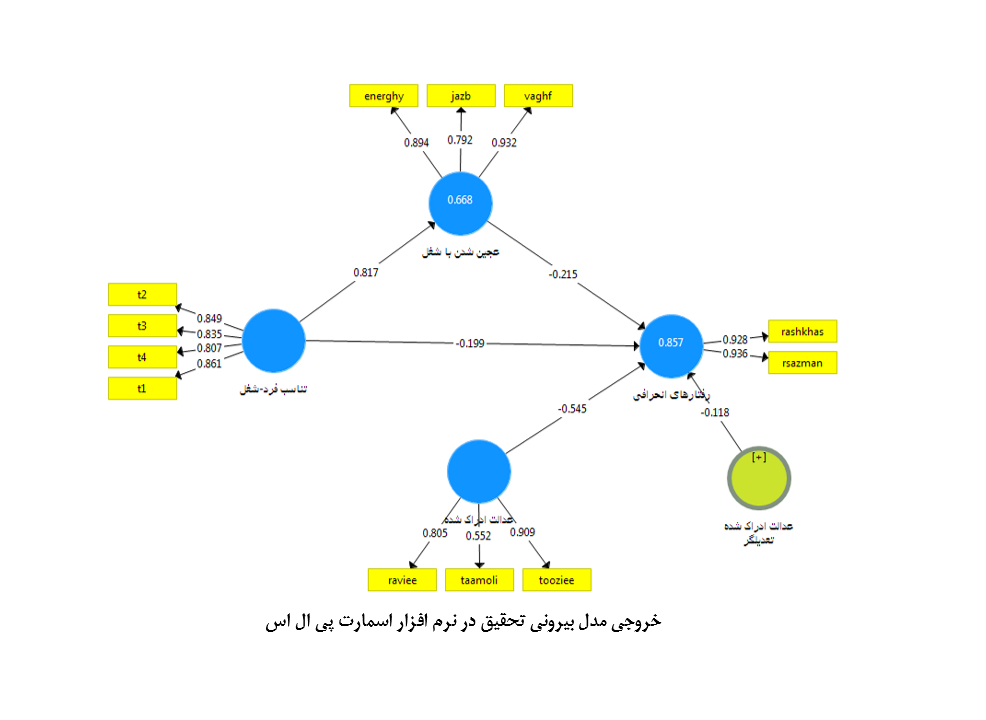
This study aimed to examine the effect of person–job fit on employees’ workplace deviance, considering the mediating role of work engagement and the moderating role of perceived organizational justice. This applied study used a quantitative, descriptive, survey-based design and structural equation modeling. The statistical population consisted of employees of Darou Pakhsh Distribution Company, from whom 302 participants were selected through simple random sampling. Data were collected using standardized questionnaires measuring person–job fit, workplace deviance, work engagement, and perceived organizational justice. The data were analyzed using partial least squares structural equation modeling through SmartPLS software. The inferential results indicated that person–job fit had a negative and significant effect on employees’ workplace deviance, with a path coefficient of -0.199, t-value of 3.688, and p-value of 0.000. Person–job fit also positively and significantly predicted work engagement, with a path coefficient of 0.817, t-value of 47.175, and p-value of 0.000. Work engagement had a negative and significant effect on workplace deviance, with a path coefficient of -0.215, t-value of 2.375, and p-value of 0.018. In addition, perceived organizational justice negatively and significantly predicted workplace deviance, with a path coefficient of -0.545, t-value of 5.141, and p-value of 0.000. The indirect effect of person–job fit on workplace deviance through work engagement was also significant. The findings suggest that reducing workplace deviance is not merely a direct consequence of person–job fit; rather, it is strengthened through work engagement and shaped by employees’ perceptions of organizational justice. Therefore, organizations should simultaneously improve job placement decisions, foster meaningful and engaging work, and enhance fairness in procedures, rewards, and managerial interactions.
Downloads
References
1. Gholipour A. Organizational Behavior Management. 12th ed. Tehran: SAMT; 2022.
2. Zhao H, Zhang M, Liu W. Workplace Deviance: A Meta-Analytic Review of Antecedents and Consequences. Journal of Organizational Behavior. 2021;42(6):789-812. doi: 10.1002/job.2540.
3. Ng TWH, Lam SSK, Feldman DC. Organizational Citizenship Behavior and Counterproductive Work Behavior: A Review and Future Directions. Annual Review of Organizational Psychology and Organizational Behavior. 2021;8:371-96. doi: 10.1146/annurev-orgpsych-012420-055211.
4. Chen Y, Li S, Xia Q, He C. The Relationship between Job Demands and Employees' Counterproductive Work Behaviors: The Mediating Effect of Psychological Detachment and Job Anxiety. Frontiers in Psychology. 2017;8:1890-8. doi: 10.3389/fpsyg.2017.01890.
5. Du J, Jin X. Exploring and Verifying the Process of Leading to Workplace Deviance: Testing the Moderated Mediation Effect of Fear of Negative Evaluation. SAGE Open. 2025;15(1). doi: 10.1177/21582440251318075.
6. Riester J, Keller J. Considering the Dark Side of Work: Bullshit Job Perceptions, Deviant Work Behavior, and the Moderating Role of Work Ethic. Journal of Business Ethics. 2025;198(3):675-93. doi: 10.1007/s10551-024-05821-w.
7. Di Stefano G, Scrima F, Parry E. The Effect of Organizational Culture on Deviant Behaviors in the Workplace. The International Journal of Human Resource Management. 2017:1-22. doi: 10.1080/09585192.2017.1326393.
8. Clark OL, Walsh BM. Civility Climate Mitigates Deviant Reactions to Organizational Constraints. Journal of Managerial Psychology. 2016;31(1):186-201. doi: 10.1108/JMP-01-2014-0021.
9. Golparvar M, Salahshour A. A Structural Model of the Relationship between Destructive Leadership, Tendency toward Violence, and Deviant Behaviors among Employees. Organizational Resource Management Research. 2016;6(2):93-123.
10. Ebrahimzadeh Dastjerdi R, Ghaed Amini Harouni A, Ebrahimpour A. The Effect of Organizational Cynicism on Deviant Workplace Behaviors through Organizational Silence and Destructive Leadership: Case Study of Islamic Azad University, Isfahan Branch. Educational Leadership and Management Research Quarterly of Allameh Tabataba'i University. 2020;5(20):1-38.
11. Arthur W, Jr., Bell ST, Villado AJ, Doverspike D. The Use of Person-Organization Fit in Employment Decision Making: An Assessment of Its Criterion-Related Validity. Journal of Applied Psychology. 2016;91(4):786. doi: 10.1037/0021-9010.91.4.786.
12. Hoffman BJ, Woehr DJ. A Quantitative Review of the Relationship between Person-Organization Fit and Behavioral Outcomes. Journal of Vocational Behavior. 2016;68(3):389-99. doi: 10.1016/j.jvb.2005.08.003.
13. Luo Z, Song L, Huang X. Misfit and Counterproductive Work Behavior: A Stress Perspective. Journal of Applied Psychology. 2021;106(9):1352-68. doi: 10.1037/apl0000832.
14. Peter M, Kavitha SF. A Survey on Workplace Behaviour: Role of Person-Job Fit and Empowerment, Evidence. 2020.
15. Sathappan M, Adamu AA. Minimizing Deviant Workplace Behaviour through Person Job Fit: A Malaysian Case Study. Asian Journal of Behavioural Sciences. 2022;4(1):52-61.
16. Zhang Y, Xu S, Li J. Person-Job Fit and Employee Outcomes: A Multilevel Perspective. Personnel Psychology. 2022;75(3):567-89. doi: 10.1111/peps.12456.
17. Yao X, Wang L, Lee Y. Person-Job Fit and Employee Performance: The Role of Job Satisfaction and Engagement. Human Resource Management Journal. 2022;32(4):845-62. doi: 10.1111/1748-8583.12398.
18. Khan J, Ali A, Saeed I, Vega-Munoz A, Contreras-Barraza N. Person-Job Misfit: Perceived Overqualification and Counterproductive Work Behavior. Frontiers in Psychology. 2022;13:936900. doi: 10.3389/fpsyg.2022.936900.
19. Fathizadeh A, Zare R, Bahmani A. Job Engagement in Nurses and Its Effect on Organizational Citizenship Behavior: The Mediating Role of Job Satisfaction. Iran Journal of Nursing. 2017;30(110):33-44.
20. Saedi MM. The Effect of Job Engagement, Job Satisfaction, and Individual Readiness for Change on the Relationship between Change Leadership and Employees' Commitment to Change [Master's thesis in Business Management, Organizational Transformation]: Allameh Tabataba'i University, Faculty of Accounting and Management; 2016.
21. Astineh A. The Effect of Employer Brand on Employee Retention Considering the Mediating Variables of Perceived Organizational Support and Employee Engagement: Case Study of Employees of the General Directorate of Sports and Youth of Kohgiluyeh and Boyer-Ahmad Province [Master's thesis]: Payame Noor University, Rasht Center; 2020.
22. Bakhshi Bejestani E. Examining the Relationship of Organizational Intimacy with Employee Voice and Job Engagement among Elementary School Teachers in Bejestan County [Master's thesis]: Islamic Azad University, Bardskan Branch; 2020.
23. Beikzad J, Razmjoo M, Tadin V. The Effect of Organizational Coaching and Self-Development on Person-Organization Fit and Human Resource Productivity with the Mediating Role of Job Engagement: A Case Study. Operations Management Quarterly. 2022;2(8).
24. Abdollahzadeh H. Examining the Relationship between Job Engagement and Person-Job Fit with the Moderating Role of Power Distance: Case Study of the Human Resources Deputy. NAJA Human Resources Scientific Quarterly. 2022;16(70).
25. Mengstie MM. Perceived Organizational Justice and Turnover Intention among Hospital Healthcare Workers. BMC Psychology. 2020. doi: 10.1186/s40359-020-0387-8.
26. Nejad Ansari Kochesfehani F. Examining the Effect of Perceived Organizational Justice on Organizational Ethics with the Mediating Role of Organizational Culture: Case Study of Tehran Municipality. Art and Culture Studies. 2022;7(22):66-73.
27. Alizadeh Sani M, Talebi H, Zamanian A. The Relationship between Employees' Perceived Justice and Managers' Behavioral Integrity: A Study in Agricultural Bank Branches of Mazandaran Province. Quarterly Journal of the Iranian Management Sciences Association. 2021;16(62):147-66.
28. Tavanegar Marvasti Z, Mohammadi Far MA, Amin Bidokhti AA. Designing a Structural Model of Organizational Justice and Determining Its Antecedents (Organizational Climate, Emotional Intelligence, and Organizational Ethical Values) and Consequences (Organizational Entrepreneurship). Journal of Psychological Science. 2020;12(86):171-81.
29. Khalili Moghadam Z, Kiani O, editors. Examining the Relationship between Organizational Justice and Workplace Deviant Behavior: Case Study of Elementary School Teachers in Lordegan. Fifteenth National Conference on Management and Humanities Research in Iran; 2023.
30. Moradi M, Hakimi I. The Mediating Role of Person-Organization Fit and Person-Job Fit in the Relationship between Organizational Justice and Organizational Citizenship Behavior and Deviant Behaviors. Public Management Perspective. 2018;9(34):67-85.
31. Qu Y, Jo W, Choi HC. Gender Discrimination, Injustice, and Deviant Behavior among Hotel Employees: Role of Organizational Attachment. Journal of Quality Assurance in Hospitality & Tourism. 2020;21(1):78-104. doi: 10.1080/1528008X.2019.1619498.
32. Goo J, Kim S, Park J. Gender Discrimination, Perceived Injustice, and Workplace Deviant Behavior: The Role of Job Engagement. Journal of Hospitality and Tourism Management. 2020;45:1-12. doi: 10.1016/j.jhtm.2020.07.003.
33. Memon KR, Zada M, Ghani B, Ullah R, Azim MT, Mubarik MS, et al. Linking Corporate Social Responsibility to Workplace Deviant Behaviors: Mediating Role of Job Satisfaction. Frontiers in Psychology. 2021;12:803481. doi: 10.3389/fpsyg.2021.803481.
34. Ghaed Amini Harouni A, Ebrahimzadeh Dastjerdi R, Ebrahimpour A. Designing a Model for Managing Deviant Workplace Behaviors at Islamic Azad University. Strategic Research on Social Problems. 2022;11(1):81-108.
35. Vilela BB, Gonzalez JAV, Ferrin PF. Person-Organization Fit, OCB and Performance Appraisal: Evidence from Matched Supervisor-Salesperson Data Set in a Spanish Context. Industrial Marketing Management. 2018;37(8):1005-19. doi: 10.1016/j.indmarman.2007.11.004.
Downloads
Publication Timeline
- Submitted
- Revised
- Accepted
Issue
Section
License
Copyright (c) 2025 Mehdi Farahani (Author); Samad Rahimi Aghdam (Corresponding author)

This work is licensed under a Creative Commons Attribution-NonCommercial 4.0 International License.