Designing a Model for Retaining Knowledge Workers with a Succession Planning Approach in the Endowment and Charity Affairs Organization of Iran: A Qualitative Study Based on Thematic Analysis
Keywords:
Knowledge worker retention, Knowledge workers, Succession planning, Endowment and Charity Affairs Organization of Iran (Oghaf)Abstract
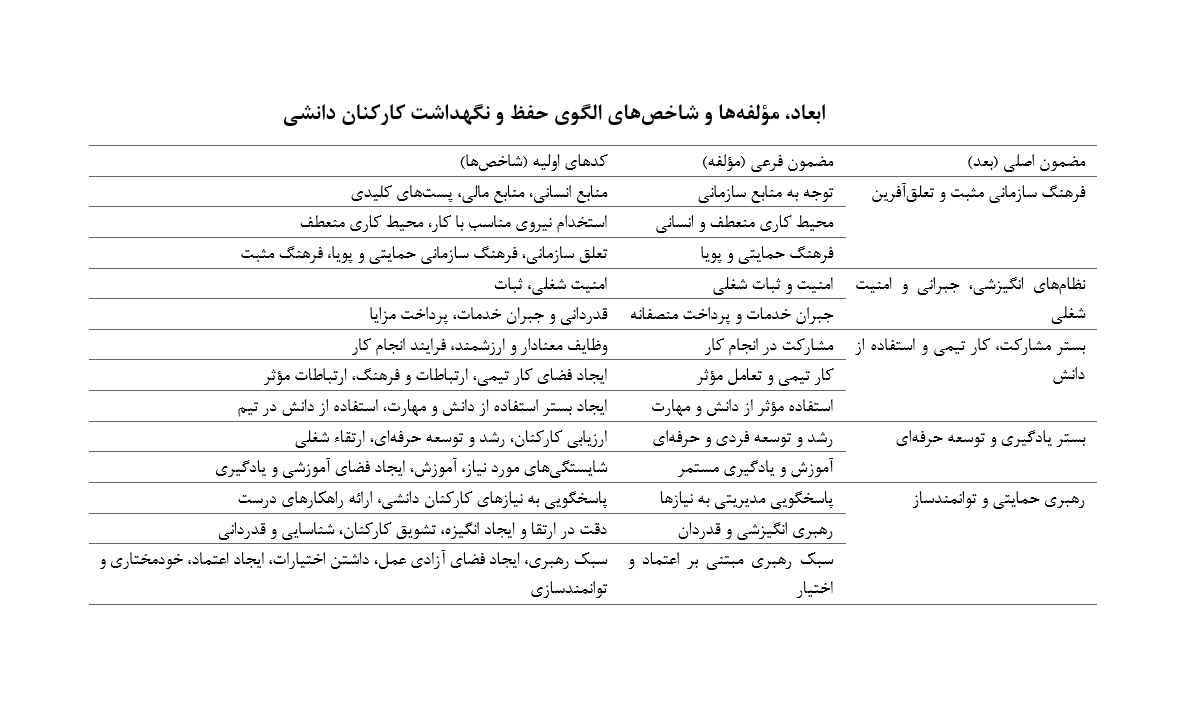
This study aimed to develop an integrated model for retaining knowledge workers by systematically linking employee retention with succession planning in the Endowment and Charity Affairs Organization of Iran. This applied study adopted a qualitative and exploratory design. Participants comprised 12 experts and senior managers of the Endowment and Charity Affairs Organization with an average of 23 years of work experience, selected through purposive snowball sampling until theoretical saturation was achieved. Data were collected through in-depth semi-structured interviews and analyzed using Braun and Clarke’s six-phase thematic analysis. A total of 313 initial codes were extracted using MAXQDA and subsequently reviewed, integrated, conceptualized, and organized into main and sub-themes. Trustworthiness was established according to Guba and Lincoln’s criteria. The proposed model was further validated through expert review and inter-coder agreement, which reached 85%. Analysis of the relationships among the themes revealed an integrated five-dimensional retention model comprising a positive and belonging-oriented organizational culture, motivational and compensation systems and job security, a platform for participation, teamwork, and effective knowledge utilization, a platform for professional learning and development, and supportive and empowering leadership. Supportive and empowering leadership and professional learning and development emerged as the dimensions exerting the strongest and most direct influence on knowledge-worker retention, whereas the effects of the remaining dimensions were partly transmitted through these mechanisms. A reciprocal and reinforcing relationship was also identified between succession planning and retention. Succession planning strengthened commitment and intention to remain by establishing visible career-development pathways and future organizational roles, while sustained retention preserved organizational knowledge and created the human-capital foundation required for knowledge transfer and successor development. Sustainable retention of knowledge workers in public organizations requires a systemic and multidimensional approach in which succession planning is embedded within retention policies. Particular emphasis should be placed on trust-based leadership, continuous professional development, effective utilization of expertise, organizational belonging, and equitable compensation to ensure both workforce continuity and the development of future organizational talent.
Downloads
References
1. Anos C. Ensuring Leadership Continuity: An Integrative Review of Succession Planning, Leadership Development and Organisational Memory. Edelweiss Applied Science and Technology. 2025;9(5):2869-77. doi: 10.55214/25768484.v9i5.7607.
2. Musale M. The Importance of Succession Planning in Talent Retention: Developing Future Leaders Within the Organization. International Journal on Research and Development – A Management Review. 2025;14(1):146-8.
3. Nurinaya N, Marhumi S. Leadership Strategy Evaluation and Succession Planning in Preparing the Company’s Future Leaders. Advances in Human Resource Management Research. 2025;3(1):1-14. doi: 10.60079/ahrmr.v3i1.405.
4. Hambrick DC, Lee EY. A model of CEO succession planning as a risky investment: Anticipated costs, uncertain results, and contingency conditions. Organization Science. 2025;36(2):677-96. doi: 10.1287/orsc.2023.17781.
5. Gunda VN, Muzira J. Leveraging predictive analytics for workforce planning, succession planning, and organizational development. 2025.
6. Zafar A, Hussain M, Mir SR. Exploring The Impact Of Succession Planning On Digital Marketing Innovation: The Mediating Role of Marketing Adaptability. Management Studies. 2025;5(1):76-86.
7. Jan Ahmadi Gol M, Rezaeifar H, Hakimpour H. Meta-analysis of Factors Affecting Succession Planning Management in Governmental Organizations. Public Management Research. 2023;16(60):191-218.
8. Keikha MA, Keikha H, editors. Investigating the Model and Challenges of Succession Planning in Government Offices. The Third International Conference on Political Science, Management, Economics, and Accounting; 2024; Hamedan.
9. Rajaei Z, Deminejad M, editors. Identifying the challenges of succession planning in Iranian public organizations. National Conference on Interdisciplinary Research in Management and Humanities; 2025.
10. Shahabi M. Presenting a Succession Planning Model in Government Organizations Using Thematic Analysis. Modern Research Approach in Management and Accounting. 2024;30(1):79-97.
11. Vahdat S, Afshari S, Masoodi Asl E, Hesam S. Key Factors Affecting Succession Planning in the Leadership of Public Hospitals in Iran: A Qualitative Study. International Journal of Healthcare Management. 2022;17(1):76-84.
12. Kamali A, Hosseini SM, Alimohammadzadeh K, Khamseh AHS. Talent identification and succession planning strategies for the appointment of nursing unit managers: A systematic review. Journal of Education and Health Promotion. 2024;13(1):485-98. doi: 10.4103/jehp.jehp_2087_23.
13. Kanu A. Health Sector Succession Planning and Management Practices in Sierra Leone: A Situation Analysis to Inform Health System Strengthening. International Journal of Leadership and Governance. 2025;5(4):40-62. doi: 10.47604/ijlg.3501.
14. Mahat R. Advancing women in government roles: Succession planning models. Government Leadership Journal. 2025;29(1):45-59.
15. Sayyahpour H, Farjad Bileh-Savar S. Human resource development through talent management and succession planning in higher education centers. Research Journal of Strategic Studies in Humanities and Islamic Sciences. 2024;5(61):1-29.
16. Keykhoshravi H, Faezi F, Heydarieh SA. Designing a model of effective factors on the implementation of succession planning in universities with a mixed approach. Journal of Sustainable Human Resource Management. 2023;5(8):171-45. doi: 10.22080/shrm.2023.4163.
17. Keerio N, Ahmad AR. Developing Future Leaders in Malaysian Public Universities: Factors Influencing the Execution of Succession Planning. Journal of Applied Research in Higher Education. 2024;16(5):1453-68.
18. Bahramzadeh S, Alavi Y, Feghi N. An Effectiveness Model of Succession Planning with an Emphasis on Fourth-Generation Universities. Studies in Resource Development and Management. 2025;1(9):1-12.
19. Upadhyaya A, Kuknor S. Challenges faced by family owned education institutions in Nepal in implementing effective succession planning strategies. Journal of Applied Research in Higher Education. 2025;17(1):175-89. doi: 10.1108/JARHE-04-2023-0151.
20. Montaghimi B, Ganjavi FA, Sajadi Hezaveh SH. Designing a competency-based succession planning model for sports managers with a qualitative approach. Strategic Studies in Sports and Youth. 2023;22(60):47-60. doi: 10.22034/ssys.2022.1651.2157.
21. Ghorani SF, Asgari N, Javashi Jadid S. Identifying and prioritizing factors affecting the success of succession planning in the defense industry. Air Defense Management. 2025;4(1):119-38.
22. Sadeghi F, Daneshfard K, Kheirandish M, Pilevari N. A succession planning model centered on organizational sustainability. Quantitative Studies in Management. 2023;14(3):78-100.
23. Sadighi Avansar S, editor Examining the relationship between work ethic, learning, and succession planning with job stress and organizational commitment among employees. Proceedings of the 5th National Conference and 2nd International Conference on New Management Patterns in Unstable Conditions; 2023: Tehran.
24. Samuel I, Mohd Isa Y. The Mediating Role of Talent Management in Succession Planning and Private Organization Sustainability: A Conceptual Article. Journal of Current Social and Political. 2024;2(1):22-33.
25. Li Z, Mustapha M, Sheikh Hassan AF, Saidin SF. The Influence of Corporate Governance on Succession Planning and Organizational Performance in Chinese Family Firms. Management Decision. 2025;63(7):2392-411.
Downloads
Publication Timeline
- Submitted
- Revised
- Accepted
Issue
Section
License
Copyright (c) 2025 Nafiseh Hilo (Author); Mashallah Valikhani Dehaghani (Corresponding author); Somayeh Ghajari (Author)

This work is licensed under a Creative Commons Attribution-NonCommercial 4.0 International License.