Modernity and the University: The Role of the University as a Modern Institution in Shaping the Life Politics of Female Students — A Qualitative Study
DOI:
https://doi.org/10.61838/jsied.337Keywords:
Modernity, university, female students, life politics, social identity, everyday lifeAbstract
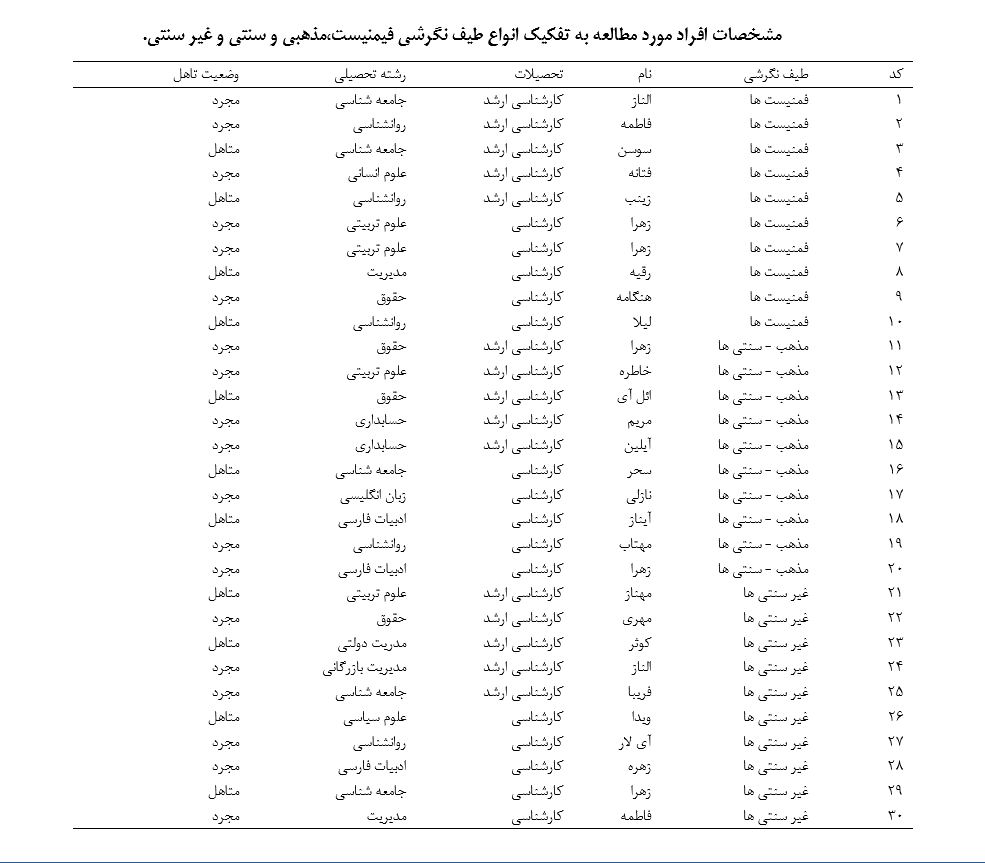
This study aimed to explore how the university as a modern institution influences the life politics of female students, their redefinition of social identity, and their strategies for confronting discrimination. A qualitative phenomenological approach was adopted. Data were collected through in-depth semi-structured interviews with 30 female students representing three identity orientations: feminist, non-traditional, and religious-traditional. Participants were recruited using purposive and snowball sampling. Data were analyzed through coding and thematic interpretation. Feminist participants highlighted the dominance of patriarchal norms and pervasive gender discrimination and emphasized resistance and self-assertion. Non-traditional participants reported job market inequalities, bodily display restrictions, educational barriers, and the historical impact of patriarchal culture, proposing education and cultural reform as solutions. Religious-traditional participants expressed relative satisfaction with women’s progress yet stressed the need for legal reforms and updated Islamic interpretations to address inequality. The university acts as a modern identity resource enabling female students to critically reconsider traditional roles, assert autonomy, and engage in self-directed life politics. Nevertheless, entrenched patriarchal structures and cultural constraints persist, requiring integrated strategies from individual empowerment to legislative and cultural transformation.
Downloads
References
Bashiriyeh H. Sociology of Modernity: Ney Publishing; 2006.
Khalegh Panah K, Sanaei A. Modernity and the Discursive Formation of Cultural Policy: A Discourse Analysis of Cultural Policy of the Government in Iran (1906-Present). Applied Sociology. 2020;31(3):57-74.
Sadri M. Modernity and Religion from a Sociological Perspective: Institute for Humanities and Cultural Studies; 2006.
Giddens A. Modernity and Self-Identity: Ney Publishing, Tehran; 2013.
Giddens A. Modernity and self-identity. Social Theory Re-Wired: Routledge; 2023. p. 477-84.
Giddens A, Nasser, Movafaghian PBTNP. Modernity and Self-Identity: Society and Personal Identity in the New Age2024.
Chavoshian H. Lifestyle and Social Identity: Consumption and Taste Preferences as Social Homogeneity in Late Modernity: Faculty of Social Sciences, University of Tehran; 2002.
Bhambra GK. Rethinking modernity: Postcolonialism and the sociological imagination: Springer Nature; 2023.
Delanty G. Formations of European modernity: A historical and political sociology of Europe: Palgrave Macmillan; 2018.
Abdolkarimi B. Modernity; A Major Obstacle to Religious Life 2019.
Serajzadeh H. The Challenges of Religion and Modernity (Sociological Discussions on Religiosity and Secularization): Tarh-e-No; 2005.
Talattof K. Modernity, Sexuality, and Ideology in Iran: The Life and Legacy of a Popular Female Artist: Syracuse University Press; 2000.
Parvin S, Felegari Z, Kiani M. Life Experiences of Girls Facing Delayed Marriage and the Typology of its Coping Strategy. Journal of Social Work Research. 2017;4(12):185-240. doi: 10.22054/rjsw.2017.10040.
Mohammad Ali Nejad Omran R, Dehghani F, Kharoushi A. Family Law Through the Lens of Modernity and Islamic Lifestyle. Scientific-Research Quarterly on Islamic Lifestyle with a Focus on Health. 2021;5(2):108-17.
Jokar M. Modernity, lifestyle changes and population decline in Iran. 2014.
Kawabata T. Anxiety in the capitalism of late modernity. Emancipations: A Journal of Critical Social Analysis. 2023;2(2):1-26. doi: 10.55533/2765-8414.1039.
Scheurich J. The white supremacist core ontological architecture of western modernity. Handbook of Critical Education Research2023.
Shabanova YO. Empathy and self-empathy in the anthropological dimension of modernity: Communal Institution of Higher Education "Dnipro Academy of Music" of Dnipropetrovsk Regional Council; 2024.
Ruhal M. From Tradition to Modernity: China’s Education System ‘‘A Product of Legal Design”. Journal of Global Research in Education and Social Science. 2025;19(1):62-80. doi: 10.56557/jogress/2025/v19i19143.
Isabella Francisca Freitas Gouveia de V, Lefrère F, Houaiss EC, Almir RogÉRio Da Silva S. Critical Modernity, Creative Thinking, and Innovation: Startups in Brazil. Cadernos Ebape Br. 2023;21(2). doi: 10.1590/1679-395120220099x.
Downloads
Publication Timeline
- Submitted
- Revised
- Accepted
Issue
Section
License
Copyright (c) 2025 Jafar Zolfalifam (Corresponding author); Nafiseh Jaberian (Author)

This work is licensed under a Creative Commons Attribution-NonCommercial 4.0 International License.