Determining the Physical Components of Flexible Learning Environments Affecting the Promotion of Collaborative Learning in Architectural Studios from Experts’ Perspectives
Keywords:
Flexible learning environment, collaborative learning, architecture studio, architecture educationAbstract
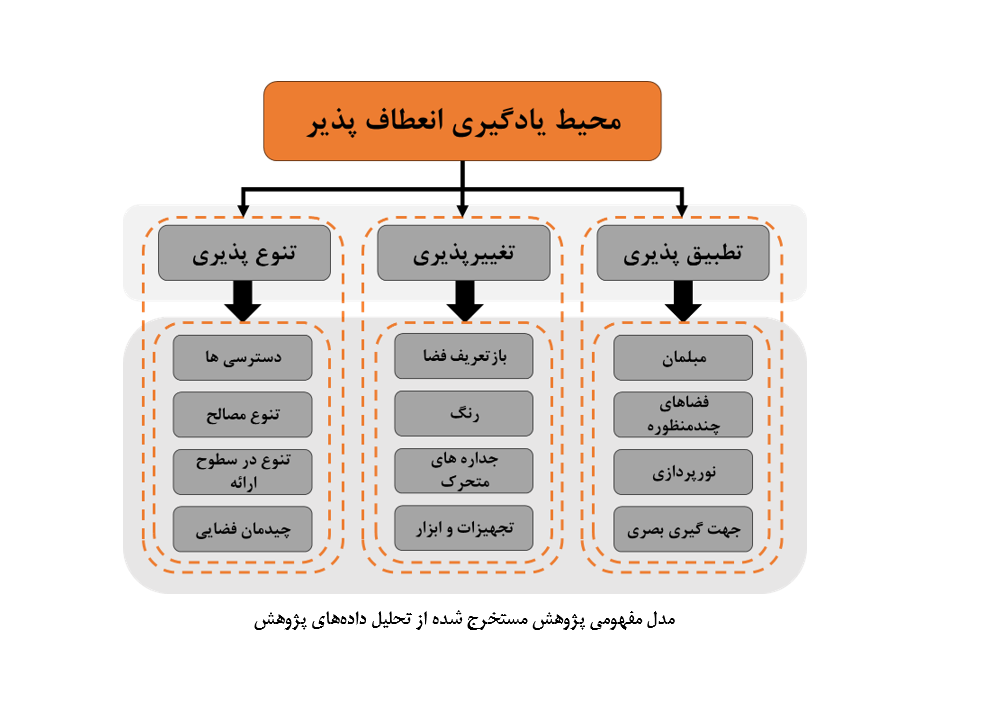
This study aimed to determine the physical components of flexible learning environments that affect the promotion of collaborative learning in architectural studios. This qualitative study was conducted using a grounded theory approach. Data were collected through semi-structured interviews with 20 architecture professors from Islamic Azad universities who had experience teaching design courses in architectural studios with different physical characteristics. Interviews continued until theoretical saturation was reached. The data were manually analyzed through open and axial coding. The analysis identified three main dimensions of the physical components of flexible learning environments: changeability, adaptability, and variability. Changeability included spatial redefinition, color, movable partitions, equipment, and tools. Adaptability included furniture, multifunctional spaces, lighting, and visual orientation. Variability included access, material diversity, diversity in presentation surfaces, and spatial arrangement. According to the experts, these components enhance interaction, teamwork, idea presentation, collective critique, and active student participation in architectural studios. The findings indicate that promoting collaborative learning in architectural studios depends on designing spaces with the capacity for change, adaptation, and spatial diversity. Therefore, attention to the physical components of flexible learning environments can provide a practical basis for redesigning architectural studios and improving the quality of design education.
Downloads
References
1. Kordestani H, Shahi S, Beiramipour A. Identifying Strategies for Making the Physical Space of Schools Learner-Oriented from Principals' Perspectives: Girls' Elementary Schools in District Two of Ahvaz. Applied Educational Leadership. 2025;6(2):45-66.
2. Yesil LB, Aras IS. The significance of flexible learning spaces and student-centred pedagogies in school settings: A comparative case study. International Education Journal: Comparative Perspectives. 2024;23(1):1-24.
3. Karvan F. Predicting Students' Self-Regulation in Architectural Design Studios Based on Problem-Solving Styles and Motivational Beliefs. Soffeh. 2024;34(3):23-38.
4. Rahnama H, Farahza N. Components and Variables Affecting Collaborative Learning in Architecture: A Review and Analysis of Findings and Identification of Gaps. Scientific Journal of Architectural Thought. 2023;7(14):35-58.
5. Johnson DW, Johnson RT, Maruyama G, Nelson D, Skon L. Effects of cooperative, competitive, and individualistic goal structures on achievement: A meta-analysis. Psychological Bulletin. 2024;89:47-62.
6. Lee WWS, Yang M. Effective collaborative learning from Chinese students' perspective: A qualitative study in a teacher-training course. Teaching in Higher Education. 2023;28(2):221-37.
7. Ghoreishi B, Jafari P, Bagheri M, Ghourchian N. Identifying the Dimensions and Components of Collaborative Learning in Elementary Schools of Bandar Abbas. Jundishapur Education Development Journal. 2021;12(0):27-38.
8. Zare Jafar M, Yousefi Tazkari A, Yousefi Tazkarali M, Ranjbar Kermani M, Yaghoubi M. Evaluating the Efficiency of the Participatory Method in Architectural Design Education: A Case Study of Architectural Design III at Islamic Azad University. Memar Shahr. 2023;2(6):40-64.
9. Karvan F. The Effect of Group-Based Concept Map Training on Increasing Creativity in Design and Problem-Solving Skills among Architecture Students. Soffeh. 2022;32(97):43-56.
10. Saghafi M, Mozaffar F, Mousavi SM. Investigating the Effect of Direct Professor-Student Participation Teaching Method on the Learning Process in Introduction to Architectural Design I. Scientific Journal of Iranian Restoration and Architecture. 2015;5(10):79-90.
11. Dinarvand A, Nadimi H, Alaei A. Educating Architecture Beginners Using a Collaborative Peer Learning Approach. Soffeh. 2017;27(4):5-18.
12. Lal Bakhsh E, Ghobadian V, Azizi S. A Model of Architectural Design Education Based on Collaborative and Interactive Thinking in Iran. Educational Technology. 2019;13(3):649-59.
13. Lal Bakhsh E, Ghobadian V, Azizi S. Presenting a Model for Collaborative Education in Architectural Design in Iranian Faculties. A New Approach in Educational Management. 2020;11(42):317-38.
14. Rodriguez C, Hudson R, Niblock C. Collaborative learning in architectural education: Benefits of combining conventional studio, virtual design studio and live projects. British Journal of Educational Technology. 2018;49(3):337-53.
15. Nazarpour MT, Heidari A, Sarmadi SM. Analysis and Investigation of the Architectural Configuration of Educational Spaces in Iranian-Islamic Schools: A Comparative Study of Public and Educational Spaces in Iranian-Islamic Schools and Contemporary Layout Models. Education Quarterly. 2021;37(2):147-76.
16. Loon M. Flexible Learning: A Literature Review 2016-2021. Advance HE, 2021.
17. Espineda-Villanueva J. Exploring flexible learning experiences. International Journal of Multidisciplinary: Applied Business and Education Research. 2024;5(12):4932-44.
18. Mahmoudi MM. Designing Educational Spaces with a Flexibility Approach. Tehran: University of Tehran Press; 2011.
19. Pressman A. Designing Relationships: The Art of Collaboration in Architecture. Tehran: Fekr-e No Publications; 2020.
20. Esmaeili A, Shahcheraghi A, Habib F. Explaining a Conceptual Model of the Effect of Flexible Architecture on Students' Social Behavior in Yards and Corridors of Elementary Schools. Scientific Journal of Architectural Thought. 2021;5(10):138-49.
21. Kariippanon KE, Cliff DP, Lancaster SJ, Okely AD, Parrish AM. Flexible learning spaces facilitate interaction, collaboration and behavioural engagement in secondary school. PLOS ONE. 2019;14(10):e0223607.
22. Shakeri M, Arghiani M, Mahvash M. The Effect of University Environment Quality on Promoting Participation in the Learning Process: Case Study of University of Bojnord. Armanshahr Architecture and Urban Development. 2021;14(37):65-77.
23. Mousavi SM, Akbarzadeh Z. Determining Physical Components Affecting the Promotion of Teamwork in Architectural Studios: A Case Study of Architecture Classrooms at the University of Mazandaran. Scientific Journal of Architectural Thought. 2021;5(9):250-62.
24. Zarneshani Asl T. Examining the Policy-Making of Architectural Components with an Approach to Improving the Quality of Educational Space. Urban and Regional Policy-Making. 2022;1(2):38-51.
25. Zandieh M, Hesari P, Zandieh A. Flexibility Methods in Updating School Architecture and Educational Approaches: A Review Article. Educational Technology. 2020;15(1):181-90.
26. Mahouti Rad P, Mousavi MH. Investigating the Effect of Open Space in School Educational Environments and Its Impact on Students. Shabak. 2019;5(7):71-8.
27. Zandi Mohab A, Dejdar O, Talisachi G. Explaining a Model for Collaborative Education in Introductory Architectural Design Studios: Action Research in Introduction to Design Studio III. Iranian Architecture and Urban Planning. 2024;15(1):127-40.
28. Soleimani Alamouti M, Talebian E, Dejdar O. The Role of Students' Collective Participation in the Architectural Design Studio Process. Architecture Studies. 2020;3(15).
29. Al-Rahmi WM, Zeki A. A model of using social media for collaborative learning to enhance learners' performance on learning. Journal of King Saud University - Computer and Information Sciences. 2016;29:526-35.
30. Noorani S. Learners' Frequent Pattern Discovering in a Dynamic Collaborative Learning Environment Designed Based on Game Theory. Technology of Education Journal. 2020:1-15.
31. Strauss A, Corbin J. Basics of Qualitative Research: Techniques and Procedures for Developing Grounded Theory. 3 ed: SAGE Publications; 2013.
Downloads
Publication Timeline
- Submitted
- Revised
- Accepted
Issue
Section
License
Copyright (c) 2025 Roya Karimi (Author); Maryam Shabak (Corresponding author); Nima Norouzi (Author)

This work is licensed under a Creative Commons Attribution-NonCommercial 4.0 International License.