Exploring the Ethical and Psychological Challenges of Integrating Generative Artificial Intelligence into the Curriculum of Iran’s Educational System: Developing a Conceptual Model
Keywords:
Generative Artificial Intelligence, Curriculum, Educational System, Ethical Challenges, Psychological Challenges, Grounded Theory, Conceptual ModelAbstract
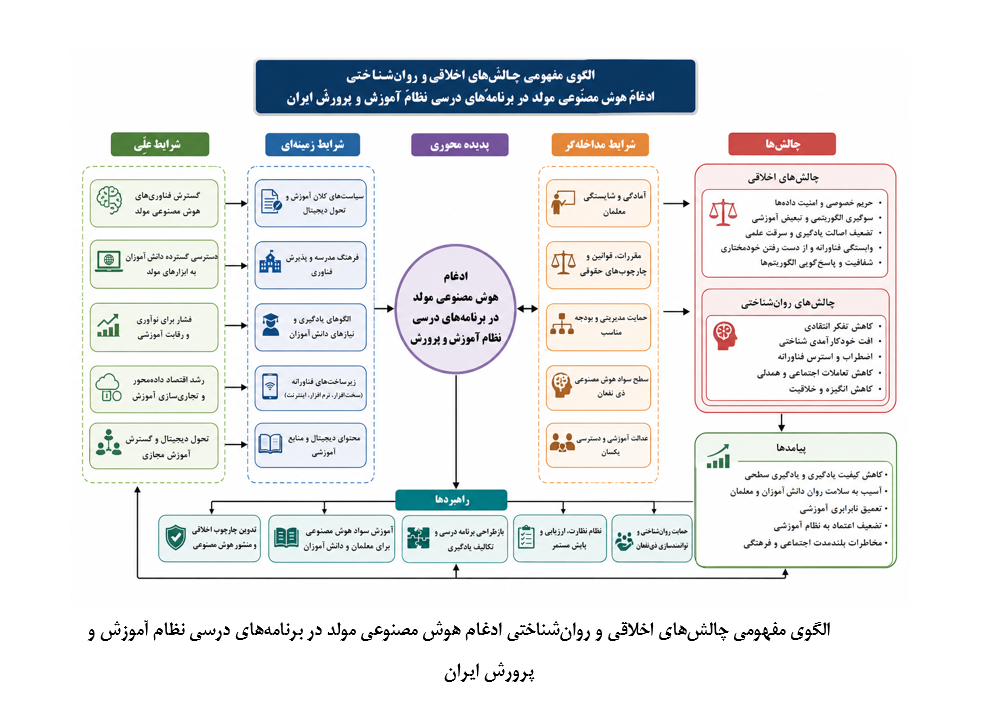
This study aimed to explore the ethical and psychological challenges associated with integrating generative artificial intelligence into the curriculum of Iran’s educational system and to develop a conceptual model explaining the determinants, consequences, and management strategies of this integration. This qualitative study was conducted using a grounded theory approach. The study population consisted of curriculum specialists, educational technologists, artificial intelligence experts, educational psychologists, ethics scholars, and educational administrators in Tehran. Participants were selected through purposive and snowball sampling, and data collection continued until theoretical saturation was achieved. A total of 22 experts participated in the study. Data were collected through semi-structured in-depth interviews and analyzed using open, axial, and selective coding procedures. To ensure trustworthiness, member checking, peer review, and constant comparative analysis were employed throughout the research process. The analysis resulted in the extraction of 281 initial codes, 12 subcategories, and 3 major categories. Findings indicated that ethical and psychological challenges constituted the most influential dimensions affecting the integration of generative AI into educational curricula. Among ethical concerns, privacy and data security, diminished learning authenticity, and algorithmic bias emerged as the most significant issues. Within the psychological domain, reduced critical thinking, decreased cognitive self-efficacy, technological dependency, and weakened social interactions were identified as the primary concerns. The findings further revealed that teacher readiness, legal frameworks, technological infrastructure, and AI literacy levels play critical roles in shaping the outcomes of AI implementation. Based on the results, a conceptual model comprising causal conditions, contextual factors, intervening conditions, strategic responses, and consequences was developed. The findings demonstrate that integrating generative artificial intelligence into educational curricula is a multidimensional process requiring simultaneous consideration of ethical, psychological, educational, and governance-related dimensions. Effective implementation depends on the establishment of ethical frameworks, enhancement of AI literacy, curriculum redesign, and the development of appropriate monitoring mechanisms. Without such measures, the risks of diminished critical thinking, privacy violations, educational inequality, and reduced learning quality are likely to increase.
Downloads
References
1. Tapalova O, Zhiyenbayeva N. Artificial Intelligence in Education: AIEd for Personalised Learning Pathways. The Electronic Journal of E-Learning. 2022;20(5):639-53. doi: 10.34190/ejel.20.5.2597.
2. Li Y, Zhao Z. The Role of Education in the Era of AI: Challenges Along With Opportunities. Journal of Humanities Arts and Social Science. 2024;8(4):1034-9. doi: 10.26855/jhass.2024.04.039.
3. Ja'ara B. Navigating the Digital Age: Adapting Education With Artificial Intelligence. International Journal of Academic Research in Progressive Education and Development. 2024;13(4). doi: 10.6007/ijarped/v13-i4/23417.
4. Easouh FYJ, Oweis TE, Makahleh HA. A Bibliometric Lens on the Future: How AI Continues to Transform Education Institutions. Human Systems Management. 2024;43(6):825-44. doi: 10.1177/01672533241305172.
5. Okunade AI. The Role of Artificial Intelligence in Teaching of Science Education in Secondary Schools in Nigeria. European Journal of Computer Science and Information Technology. 2024;12(1):57-67. doi: 10.37745/ejcsit2013/vol12n15767.
6. Katenova M, Turmaganbetova K. Artificial Intelligence and Business School Students’ Performance. International Journal of Religion. 2024;5(8):96-101. doi: 10.61707/6wjvxp71.
7. Slimi Z, Villarejo-Carballido B. Systematic Review: AI's Impact on Higher Education - Learning, Teaching, and Career Opportunities. Tem Journal. 2023:1627-37. doi: 10.18421/tem123-44.
8. E. R. Emerging Professions in the Age of AI Across Multiple Sectors. International Journal for Multidisciplinary Research. 2024;6(5). doi: 10.36948/ijfmr.2024.v06i05.28762.
9. E. R. AI'S Impact on Vocational Training and Employability: Innovation, Challenges, and Perspectives. International Journal for Multidisciplinary Research. 2024;6(4). doi: 10.36948/ijfmr.2024.v06i04.24967.
10. Omri A, Omri H, Afi H. Exploring the Impact of AI on Unemployment for People With Disabilities: Do Educational Attainment and Governance Matter? Frontiers in Public Health. 2025;13. doi: 10.3389/fpubh.2025.1559101.
11. Jawaid SA, Ahmed S. The Transformative Economic Impact of Artificial Intelligence. 2023. doi: 10.20944/preprints202311.1384.v1.
12. Tan MJT, Nicholle Mae Amor Tan M. Shaping Integrity: Why Generative Artificial Intelligence Does Not Have to Undermine Education. Frontiers in Artificial Intelligence. 2024;7. doi: 10.3389/frai.2024.1471224.
13. Imtiaz Q. Artificial Intelligence: A Double-Edged Sword for the Education and Environment of the Global Market. Eatp. 2024:3181-93. doi: 10.53555/kuey.v30i6.6013.
14. Babu PP, Vasumathi A. Contemporary Issues in Applying AI Applications: Challenges and Opportunities. Multidisciplinary Reviews. 2023;6(1):2023010. doi: 10.31893/multirev.2023010.
15. Slimi Z, Villarejo-Carballido B. Navigating the Ethical Challenges of Artificial Intelligence in Higher Education: An Analysis of Seven Global AI Ethics Policies. Tem Journal. 2023:590-602. doi: 10.18421/tem122-02.
16. Huang L. Ethics of Artificial Intelligence in Education: Student Privacy and Data Protection. Science Insights Education Frontiers. 2023;16(2):2577-87. doi: 10.15354/sief.23.re202.
17. Hong C. The Ethical Challenges of Educational Artificial Intelligence and Coping Measures: A Discussion in the Context of the 2024 World Digital Education Conference. Science Insights Education Frontiers. 2024;20(2):3263-81. doi: 10.15354/sief.24.re339.
18. Yan Y, Liu H, Chau T. A Systematic Review of AI Ethics in Education. Journal of Global Information Management. 2025;33(1):1-50. doi: 10.4018/jgim.386381.
19. Kronivets T, Yakovenko O, Tymoshenko Y, Ilnytskyi M. Dimensions of Legal and Moral Use of Artificial Intelligence in Education. Rev Artif Intell Educ. 2024;5:e025. doi: 10.37497/rev.artif.intell.educ.v5i00.25.
20. Giarmoleo FV, Ferrero I, Rocchi M, Pellegrini MM. What Ethics Can Say on Artificial Intelligence: Insights From a Systematic Literature Review. Business and Society Review. 2024;129(2):258-92. doi: 10.1111/basr.12336.
21. Ríos-Campos C, Tejada-Castro MI, Jessica Del Consuelo Luzuriaga V, Zambrano EOG, Núñez JB, Vara FEO. Ethics of Artificial Intelligence. South Florida Journal of Development. 2023;4(4):1715-29. doi: 10.46932/sfjdv4n4-022.
22. Osasona F, Daraojimba AI, Atadoga A, Onwusinkwue S, Chimezie O, Dawodu SO. Ai Integration in Business Analytics: A Review of Usa and African Trends. Computer Science & It Research Journal. 2024;5(2):432-46. doi: 10.51594/csitrj.v5i2.793.
23. Lescrauwaet L, Wagner H, Yoon CY, Shukla S. Adaptive Legal Frameworks and Economic Dynamics in Emerging Tech-Nologies: Navigating the Intersection for Responsible Innovation. Law and Economics. 2022;16(3):202-20. doi: 10.35335/laweco.v16i3.61.
24. Sharma AK, Sharma R. Governance in the Age of Artificial Intelligence: A Comparative Analysis of Policy Framework in BRICS Nations. Ai Magazine. 2025;46(2). doi: 10.1002/aaai.70010.
25. Mbaidin HO, Sbaee NQ, AlMubydeen IO, Chindo UM, Alomari KM. The Role of AI Integration and Governance Standards: Enhancing Financial Reporting Quality in Islamic Banking. Decision Science Letters. 2024;13(1):83-98. doi: 10.5267/j.dsl.2023.12.001.
26. Arianto H. Readiness of the Legal Education System in Indonesia in Facing the Era of Artificial Intelligence. International Journal of Social Health. 2024;3(2):155-62. doi: 10.58860/ijsh.v3i2.163.
27. Cinar AB, Bilodeau S. Incorporating AI Into the Inner Circle of Emotional Intelligence for Sustainability. Sustainability. 2024;16(15):6648. doi: 10.3390/su16156648.
28. Alshahrani BT, Pileggi SF, Karimi F. A Social Perspective on AI in the Higher Education System: A Semisystematic Literature Review. Electronics. 2024;13(8):1572. doi: 10.3390/electronics13081572.
29. Xiong Y, Que L, Liu J. Educational Missions and Tactics in the EU Artificial Intelligence Strategy in the Era of Digital Transformation: A Policy Analysis Based on EU Documents Published During 2018–2022. 2023. doi: 10.3233/atde230999.
30. Tarisayi KS. Strategic Leadership for Responsible Artificial Intelligence Adoption in Higher Education. Cte Workshop Proceedings. 2024;11:4-14. doi: 10.55056/cte.616.
31. At-tamimi RMR, Abidin A, Amiruddin A. Integrating Artificial Intelligence Into Succession Planning and Leadership Development in Higher Education. Icobuss. 2024:209-28. doi: 10.24034/icobuss.v4i1.496.
32. Olusola OB, Benedict BS, Olusola SE. Perspective Chapter: Leveraging Artificial Intelligence in a Blotch Academic Environment. 2024. doi: 10.5772/intechopen.1004792.
33. Osasona F, Amoo OO, Atadoga A, Abrahams TO, Farayola OA, Ayinla BS. Reviewing the Ethical Implications of Ai in Decision Making Processes. International Journal of Management & Entrepreneurship Research. 2024;6(2):322-35. doi: 10.51594/ijmer.v6i2.773.
34. Ahmad S. The Impact of Artificial Intelligence on Business &Amp; Social Values: Benefits, Challenges, and Future Directions. Eatp. 2024:3174-80. doi: 10.53555/kuey.v30i6.6012.
35. Firnando HG, Wahyudi M. The Role of Artificial Intelligence in Shaping the Islamic Worldview of the Digital Economy. Journal of Islamic Economics and Philanthropy. 2024;6(3):231-49. doi: 10.21111/jiep.v6i3.11386.
36. Amedior NC. Ethical Implications of Artificial Intelligence in the Healthcare Sector. Advances in Multidisciplinary & Scientific Research Journal Publication. 2023;36:1-12. doi: 10.22624/aims-/accrabespoke2023p1.
37. Kwon J. A Study on Ethical Awareness Changes and Education in Artificial Intelligence Society. Revue D Intelligence Artificielle. 2023;37(2):341-5. doi: 10.18280/ria.370212.
Downloads
Publication Timeline
- Submitted
- Revised
- Accepted
Issue
Section
License
Copyright (c) 2025 Mehdi Akbarzadeh Sagay, Parisa Masoudian, Ahmadzadeh Ahmadzadeh (Author); Nasrin Mohaddes (Corresponding author)

This work is licensed under a Creative Commons Attribution-NonCommercial 4.0 International License.