Presenting a Model for Assessing the Level of E-Learning Readiness and Maturity Among Teachers in Tehran's Second-Stage Secondary Schools with a Qualitative Approach
DOI:
https://doi.org/10.61838/jsied.468Keywords:
E-learning readiness, E-learning maturity, Secondary school teachers, Digital transformation, Technological skillsAbstract
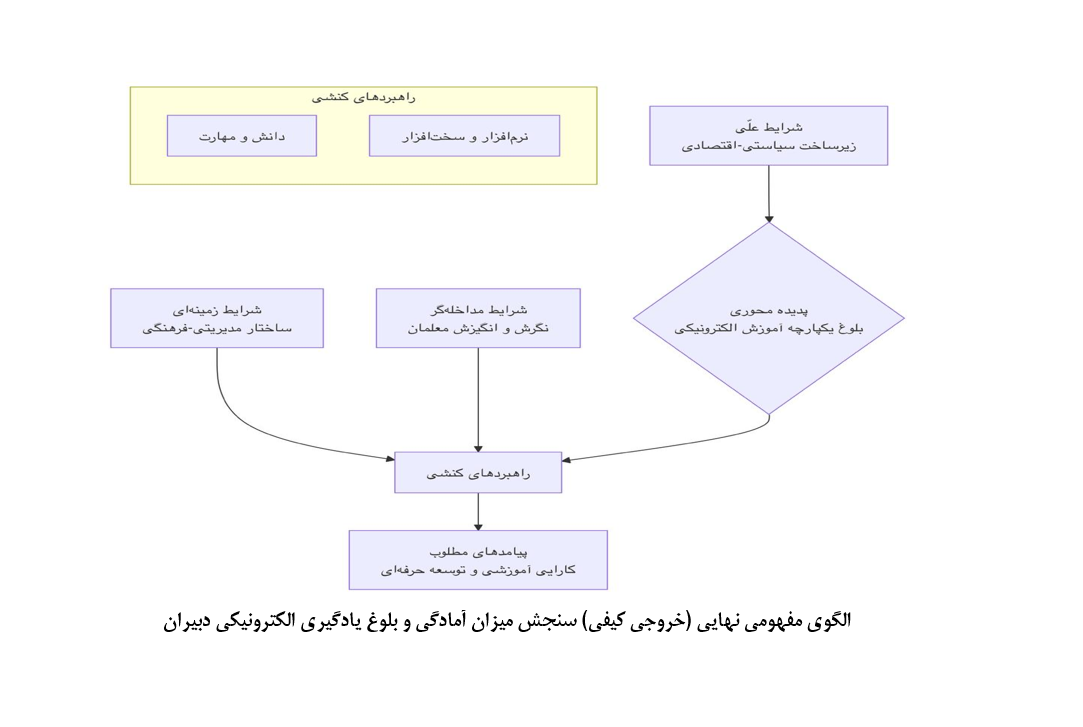
With the advancement of information and communication technology, e-learning has gained significant importance as a modern educational approach, and the readiness and maturity of teachers in utilizing these technologies play a crucial role in its success. The present study aimed to develop a model for assessing the readiness and maturity of e-learning among secondary school teachers in Tehran. This study is applied in purpose and qualitative in nature, following a grounded theory approach. The qualitative sample consisted of experts in the fields of education and educational technology, while the quantitative sample included secondary school teachers in Tehran. Sampling was conducted using purposive snowball sampling, and the sample size was determined based on theoretical saturation. Findings revealed that e-learning maturity is a multidimensional phenomenon shaped by individual, organizational, professional, and technological factors. Teachers demonstrated high readiness and motivation to utilize educational technologies; however, infrastructural limitations, weak management and organizational culture, and insufficient professional and technological skills hindered their full utilization of e-learning capacities. Additionally, three levels of maturity—initial, dynamic, and advanced—were identified among teachers, each requiring tailored educational planning and managerial support. Based on the results, the proposed model can serve as a comprehensive tool for evaluating and enhancing teachers’ readiness and e-learning maturity, contributing to educational decision-making, professional development, and teaching quality improvement. The study emphasizes that only by strengthening infrastructure, technological skills, and supportive organizational environments can full e-learning maturity be achieved, enabling teachers to effectively drive digital transformation in education.
Downloads
References
1. Hébert C, Jenson J, Terzopoulos T. "Access to technology is the major challenge": Teacher perspectives on barriers to DGBL in K-12 classrooms. E-Learning and Digital Media. 2021;18(3):307-24. doi: 10.1177/2042753021995315.
2. Cao CD, Vu HTT, Nguyen TV, Nguyen HT, Nguyen TVH. Evaluating Model Teacher Education and Training at Vietnam's Universities of Technology and Education. Journal of Education and E-Learning Research. 2023;10(2):307-13. doi: 10.20448/jeelr.v10i2.4612.
3. Hajizadeh A, Azizi G, Keyhan G. Analyzing the opportunities and challenges of e-learning in the Corona era: An approach to the development of e-learning in the post-Corona. Research in Teaching. 2021;9(1):204-174.
4. Çınar M, Ekici M, Demir Ö. A snapshot of the readiness for e-learning among in-service teachers prior to the pandemic-related transition to e-learning in Turkey. Teaching and Teacher Education. 2021;107:103478. doi: 10.1016/j.tate.2021.103478.
5. Zare Z, Salehi K, Javadipour M. Designing an Indicators System for Evaluation of the Performance of Teachers in E-learning Environments. Journal of Training & Learning Researches. 2023;20(1):64-78.
6. Zarifsanaiey N, Farrokhi MR, Karimian Z, Hoseini S, Chahartangi F, Shahraki HR. Lesson learned from assessing teachers’ and students’ perspectives regarding the quality of e-learning in medical education during the pandemic: a mixed-methods study. BMC Medical Education. 2024;24(1):171.
7. Taghizadeh H, Karimi Y, Noroozi F. Technological skills of teachers and educational self-efficacy. Journal of E-Learning Studies. 2023;14(1):112-35.
8. Mosayabi M, Rezapour S, Behjati F. Problems and Challenges of E-learning During the COVID-19 Pandemic in Primary Education. Educational Studies Quarterly, University of Teacher Education. 2021;7(27):25-35.
9. Khalvandi F, Emadi SR, Omrani MA. Designing and Validating a Conceptual Model for Managing E-Learning Environments for Teachers. 2023.
10. Qazi MA, Sharif MA, Akhlaq A. Barriers and facilitators to adoption of e-learning in higher education institutions of Pakistan during COVID-19: perspectives from an emerging economy. Journal of Science and Technology Policy Management. 2024;15(1):31-52. doi: 10.1108/JSTPM-01-2022-0002.
11. Soltani H. Teachers' skill development in e-learning environments. Journal of Educational Media Research. 2022;9(2):123-35.
12. Polat E, Hopcan S, Yahşi Ö. Are K–12 Teachers Ready for E-Learning? The International Review of Research in Open and Distributed Learning. 2022;23(2):214-41. doi: 10.19173/irrodl.v23i2.6082.
13. Daneshvar A, Homayounfar M, Fadaei Eshkiki M, doshmanziari e. Developing a Model for Performance Evaluaion of Teachers in Electronic Education System Using Adaptive Neuro Fuzzy Inference System (ANFIS). Journal of New Approaches in Educational Administration. 2021;12(4):176-90. doi: 10.30495/jedu.2021.22870.4633.
14. Rafique R. Supporting teachers through online professional development: A small-scale qualitative study with teachers in Bangladesh. Open Learning: The Journal of Open, Distance and e-Learning. 2024;39(2):185-201. doi: 10.1080/02680513.2024.2316629.
15. Schröder A, Cammann F, Darge K, Krepf M, Weyers J, König J. Development of student teachers' research competence in the context of research-based learning: a longitudinal study on the effects of an e-learning-supported intervention. Zeitschrift für Erziehungswissenschaft. 2025. doi: 10.1007/s11618-025-01342-y.
16. Koreňová L, Krpec R, Barot T. Digital Technologies in Primary Mathematics Education: Insights From Future Teachers’ Portfolios. European Conference on E-Learning. 2024;23(1):197-208. doi: 10.34190/ecel.23.1.2929.
17. Mirani Sargazi N, Hafezi A, Mofakhami A, Besharat Nia MS. The importance and role of strategic planning in the application of e-learning in higher education. Journal of New Approaches in Educational Sciences. 2021;3(3):38-47.
18. Prasetia I, Akrim. The impact of teacher empowerment on school effectiveness: A mixed-methods study. Journal of Education and E-Learning Research. 2024;11(4):655-66. doi: 10.20448/jeelr.v11i4.6056.
19. Tari N, Zarghami S, Mahmoodnia A, Ghaedi Y. The nature of the relationship between teacher and learner in comprehensive e-learning process with an emphasis on ideas of Deleuze. Technology of Education Journal (TEJ). 2020;14(3):521-32. doi: 10.22061/jte.2019.3988.1970.
20. Yazdani F. Teachers' Individual Readiness for E-Learning in Secondary Schools. Tehran: Tarbiat Modares University Press; 2020.
21. Siregar E, Nurtanto M, Mutohhari F, Majid NWA, Kurdi MS. Mediating Role of Teachers’ Self-Efficacy and Psychological Capital in Determining Success During Learning Transition Periods in Vocational Education. Journal of Education and E-Learning Research. 2022;9(3):207-15. doi: 10.20448/jeelr.v9i3.4193.
22. Hussein AA. The Impact of E-Learning on the Professional Development of Arabic Language Teachers in Iraq, according to their Point of View. Rivista Italiana di Filosofia Analitica Junior. 2023;14(2).
23. Hofmeister C, Pilz M. Using e-learning to deliver in-service teacher training in the vocational education sector: Perception and acceptance in Poland, Italy and Germany. Education Sciences. 2020;10(7):182. doi: 10.3390/educsci10070182.
Downloads
Publication Timeline
- Submitted
- Revised
- Accepted
Issue
Section
License
Copyright (c) 2025 Ali Mikaeilpour, Fatemeh Hamidifar, Abbas Khorshidi, Baharak Shirzadkebria (Author)

This work is licensed under a Creative Commons Attribution-NonCommercial 4.0 International License.