The Presentation of a Causal Model Illustrating the Impact of Effective Factors on the Personal Development of Teachers’ Job Satisfaction in the Education System
Keywords:
Job satisfaction, personal development, professional development, teachers, structural equation modeling, organizational factorsAbstract
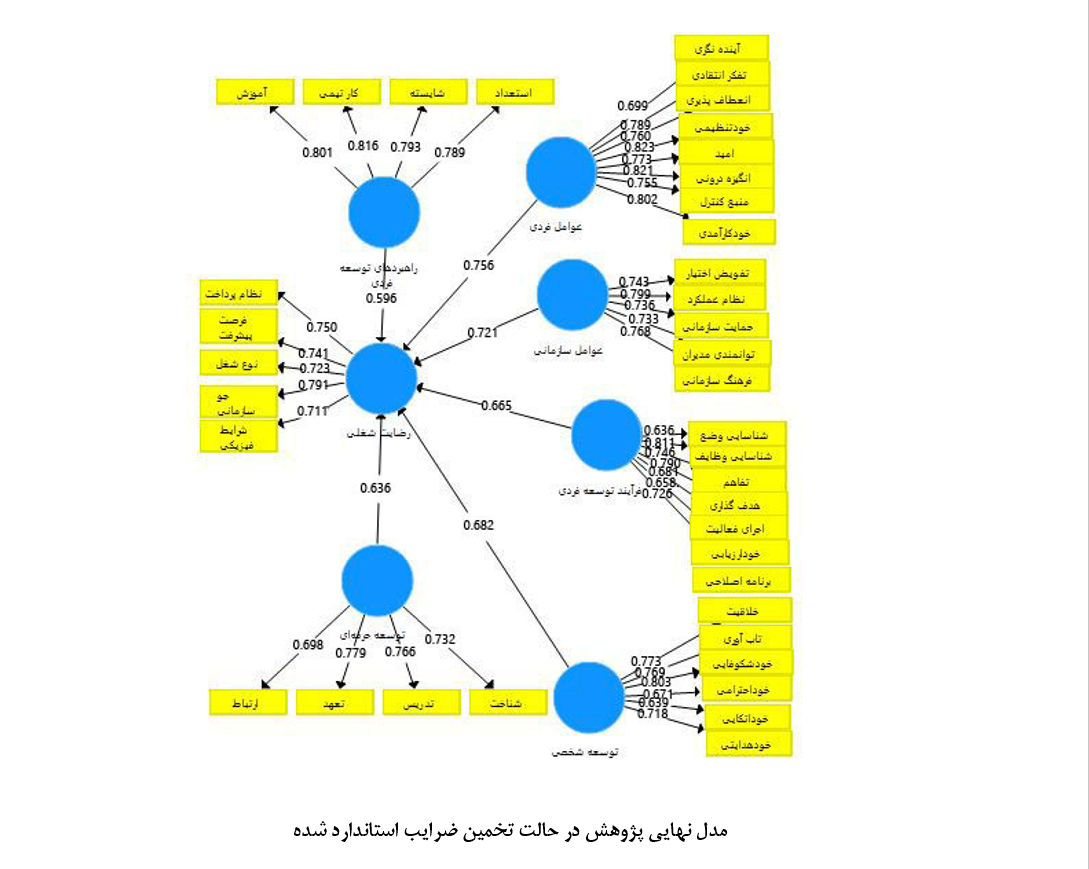
The present study aimed to develop a causal model explaining the effects of personal development factors on teachers’ job satisfaction in the education system. This applied study employed a descriptive-correlational design using a survey method. The statistical population consisted of teachers working in the education system of Fars Province during the 2023–2024 academic year. Based on Cochran’s formula, 400 questionnaires were distributed, and after excluding incomplete forms, data from 385 teachers were analyzed. Participants were selected through simple random sampling. Data collection instruments included the Minnesota Satisfaction Questionnaire (MSQ) for assessing job satisfaction and the Personal Development Questionnaire developed by Ghorbanian et al. The personal development scale consisted of six dimensions: individual factors, organizational factors, personal development process, personal development strategies, personal growth, and professional development. Content validity was confirmed by experts, and reliability coefficients indicated acceptable internal consistency. Data were analyzed using Structural Equation Modeling (SEM) with SPSS-24 and SmartPLS-3 software. The findings demonstrated that all dimensions of personal development had significant positive effects on teachers’ job satisfaction. Individual factors showed the strongest effect on job satisfaction (β=0.756, t=8.641). Organizational factors (β=0.721), personal growth (β=0.682), personal development process (β=0.665), professional development (β=0.636), and personal development strategies (β=0.596) also significantly predicted job satisfaction (p<0.001). The overall model demonstrated a strong goodness-of-fit index (GOF=0.731), confirming the adequacy of the proposed structural model. The results suggest that strengthening personal competencies, organizational support, developmental planning, and professional growth can substantially improve teachers’ job satisfaction. The results indicate that personal development is a critical component of educational human resource management and plays a significant role in enhancing teachers’ job satisfaction. Emphasizing individual and organizational factors, implementing structured developmental processes, and supporting teachers’ professional growth can improve educational quality, organizational commitment, and institutional effectiveness. Therefore, educational policymakers and administrators should prioritize personal development programs as a strategic approach to improving teachers’ work environments and increasing educational productivity.
References
1. Tu L, Jiang H, Dai L. Technostress, Burnout, and Job Satisfaction: An Empirical Study of STEM Teachers’ Well-Being and Performance. Behavioral Sciences. 2025;15(7):992. doi: 10.3390/bs15070992.
2. Hasselbring J. Teacher Emotional Intelligence and Job Satisfaction: Trevecca Nazarene University; 2025.
3. Ghorbanian P, Taghipoorzaheer A, Zamanymighadam A, Ardalan MR. Structural Model of Individual Development of Exceptional School Teachers: Case: Hamadan Province. Educational and Scholastic Studies. 2022;11(3):385-404.
4. Ramadhinta E, Cahyadi E, Sukmawati A. Managerial Competencies Development of Oil Palm Plantation Managers for Industry 4.0 Era. Journal Management & Agriculture. 2022;19(1):34-46. doi: 10.17358/jma.19.1.24.
5. Yu X, Li Z. The Relationship Between Self-Efficacy and Job Satisfaction: A Meta-Analysis From the Perspective of Teacher Mental Health. Healthcare. 2025;13(14):1715. doi: 10.3390/healthcare13141715.
6. Turan C, Demirtaş Z, Fidan K. Investigating the Relationship between Self-Efficacy and Job Satisfaction: A Research on High School Teachers. Eğitim Yansımaları. 2023;7(1):1-12.
7. Rossiandy Y, Indradewa R. The Influence of Self-Efficacy on Job Satisfaction, Organizational Commitment, Motivation and Job Performance in Private School Teachers. Asian Journal of Social and Humanities. 2023;1(10):632-49. doi: 10.59888/ajosh.v1i10.74.
8. Lu D, Zhao G, Lee SY, Jun T. Impact of Motivation and Incentives on Job Performance and Job Satisfaction: An Empirical Study on Dance Teachers’ Career Development. International Journal of Innovative Research and Scientific Studies. 2025;8(7):713-9. doi: 10.53894/ijirss.v8i7.10528.
9. Yildiz VA, Kiliç D. Investigation of the Relationship between Class Teachers' Motivation and Job Satisfaction. International Online Journal of Education and Teaching. 2021;8(1):119-31.
10. Akosile AL, Ekemen MA. The Impact of Core Self-Evaluations on Job Satisfaction and Turnover Intention among Higher Education Academic Staff: Mediating Roles of Intrinsic and Extrinsic Motivation. Behavioral Sciences. 2022;12(7):236. doi: 10.3390/bs12070236.
11. Moosivand M, Solgi M. The Role of Critical Thinking and Psychological Capitals in Predicting Job Satisfaction of Married Teachers in Tehran. Educational and Scholastic Studies. 2022;11(2):577-99.
12. Çengel AB, Elif ATEŞ, Esra UĞUR. Investigating the Relationship Between Critical Thinking Disposition and Job Satisfaction Among Critical Care Nurses. CURARE Journal of Nursing. 2023(1):29-37. doi: 10.26650/CURARE.2023.005.
13. Yusuf MYM, Nuraeni N. The Effect of Perceived Organizational Support, Job Involvement, and Career Development on Job Satisfaction and Its Implications for Organizational Commitment. Sosiohumaniora. 2023;25(1). doi: 10.24198/sosiohumaniora.v25i1.38649.
14. Gaddi ZA, Prado JC, Davalos HA. Constructs of Organizational Support Influencing Job Satisfaction among School Personnel during Pandemic. 2023. doi: 10.47760/cognizance.2023.v03i04.001.
15. Kumar S. A Study on Impact of Performance Management System on Employee Engagement and Job Satisfaction in Healthcare Sector. 2023.
16. Kang H, Mavrogordato M. Examining the Relationship between Multiple Facets of Professional Development and Teacher Job Satisfaction in the United States. Educational Studies. 2023:1-26. doi: 10.1080/03055698.2023.2256921.
17. Ilgan A, Basaran Y. Examining Types and Duration of Teachers' Professional Development Activities and Their Relationship with Job Satisfaction. Acta Educationis Generalis. 2023;13(2):96-119. doi: 10.2478/atd-2023-0016.
18. Grinshtain Y, Avidov Ungar O, Barenboim E. Job Satisfaction and Professional Development among Teachers Working under Two Parallel Top-Down Reforms. Teacher Development. 2023;27(2):214-33. doi: 10.1080/13664530.2023.2169748.
19. Gupta A, Chadha A, Tiwari V, Varma A, Pereira V. Sustainable Training Practices: Predicting Job Satisfaction and Employee Behavior Using Machine Learning Techniques. Asian Business & Management. 2023:1-24. doi: 10.1057/s41291-023-00234-5.
20. Achmad LI, Noermijati N, Rofiaty R, Irawanto DW. Job Satisfaction and Employee Engagement as Mediators of the Relationship Between Talent Development and Intention to Stay in Generation Z Workers. International Journal of Professional Business Review. 2023;8(1):6. doi: 10.26668/businessreview/2023.v8i1.814.
21. Ahmad N, Abdullah MS, Sakarji SR. Examining the Effect of Teamwork and Employee Job Satisfaction in an Organisation. International Journal of Academic Research in Business and Social Sciences. 2023;1(11):1-10. doi: 10.6007/IJARBSS/v13-i11/19418.
22. Bragadóttir H, Kalisch BJ, Flygenring BG, Tryggvadóttir GB. The Relationship of Nursing Teamwork and Job Satisfaction in Hospitals. SAGE Open Nursing. 2023;9:23779608231175027. doi: 10.1177/23779608231175027.
23. Susanto AH, Kramadibrata B. Investigation on the Effect of Work Flexibility Policy on Job Satisfaction and Performance of Millennial Generation Employees in Start-UP Companies in DKI Jakarta. JISIP (Jurnal Ilmu Sosial dan Pendidikan). 2023;7(4):3544-56. doi: 10.58258/jisip.v7i4.6160.
24. Oktavian D, Supeno B. Locus of Control and Job Satisfaction with Work Life Balance as Mediation. Sains Organisasi. 2023;2(2):80-92.
25. Wang H, Lei L. Proactive Personality and Job Satisfaction: Social Support and Hope as Mediators. Current Psychology. 2021:1-10. doi: 10.1007/s12144-021-01379-2.
26. Abdolmanafi V, Shami S, Koraneh AE. Examining the Relationship between Creativity and Resilience in Predicting Nurses' Job Satisfaction during the Covid-19 Pandemic. International Journal of Innovation Management and Organizational Behavior (IJIMOB). 2023;3(3):1-7. doi: 10.61838/kman.ijimob.3.3.1.
27. Ashiq M, Jabeen F, Mahmood K. Workplace Creativity and Job Satisfaction of Academic Librarians: A Perspective of Distributed Leadership Theory. Information Development. 2023;39(3):500-11. doi: 10.1177/02666669221136864.
28. Ghasemi M, Hosseini M, Sharifiarjomand F. Investigating the Mediating Role of Organizational Commitment in the Relationship Between Mentoring and Job Satisfaction. Public Management Researches. 2023;16(60):299-325.
29. Sutanti M, Sandroto CW. Core Self-Evaluation and Job Satisfaction: Mediating Role of Career Commitment. Review of Management and Entrepreneurship. 2021;5(2):93-112. doi: 10.37715/rme.v5i2.1647.
Downloads
Publication Timeline
- Submitted
- Revised
- Accepted
Issue
Section
License
Copyright (c) 2025 Arefe Hoseinie, Fahime Rajabi, Nooshafarin Safari, Parvane Dodman (Author)

This work is licensed under a Creative Commons Attribution-NonCommercial 4.0 International License.