Artificial Intelligence and the Reconfiguration of Rational Action: A Grounded Model of Ethical and Social Dimensions
Keywords:
Artificial intelligence, rational action, ethics of technology, grounded theory, social rationality, human agency, technological governance.Abstract
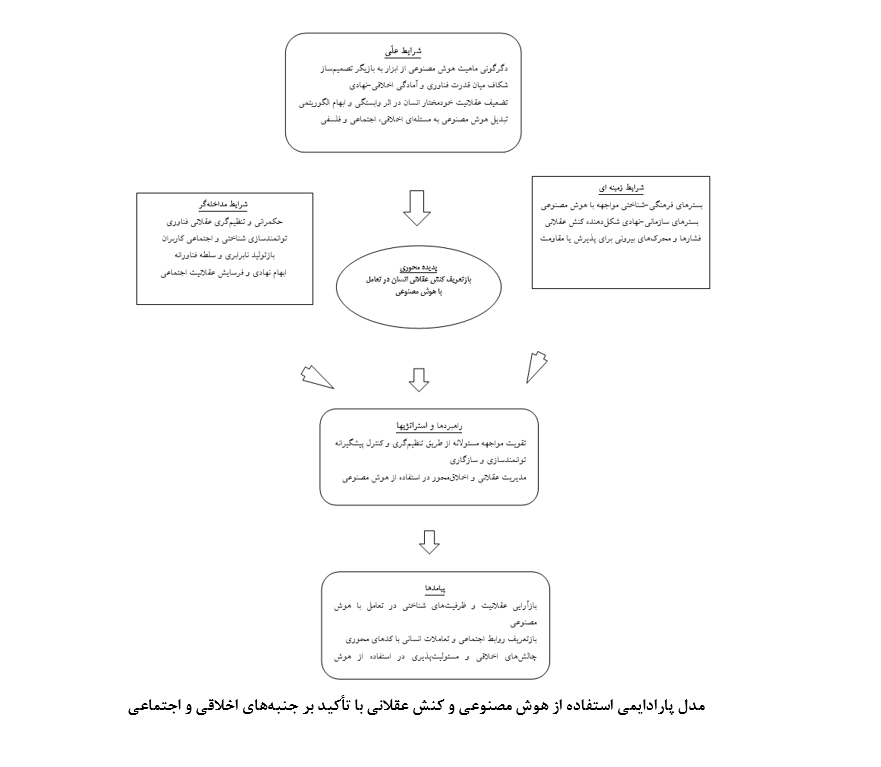
This study aimed to sociologically explain how artificial intelligence reconfigures human rational action, with particular emphasis on its ethical, social, cognitive, and institutional dimensions. This qualitative study employed the Strauss and Corbin grounded theory approach. Participants comprised 20 artificial intelligence specialists, moral philosophers, social scientists, policymakers, and end users of AI, selected through theoretical and snowball sampling, with interviews continuing until theoretical saturation was achieved. Data were collected through in-depth semi-structured interviews and analyzed using open, axial, and selective coding. The analytical process generated 136 initial concepts, 54 subcategories, and 22 major themes, which were organized within a paradigmatic framework encompassing causal, contextual, and intervening conditions, action/interaction strategies, and consequences. The analysis identified “redefinition of human rational action in interaction with artificial intelligence” as the core category. Causal conditions comprised the transformation of AI from a supportive tool into a decision-making actor, the gap between technological capability and ethical-institutional preparedness, erosion of autonomous rationality through algorithmic dependence and opacity, and the emergence of AI as an ethical, social, and philosophical issue. Cultural-cognitive and organizational-institutional contexts, together with environmental pressures, shaped the rational adoption and use of AI. Rational governance and regulation, cognitive and social empowerment of users, concentration of technological power and digital inequality, and institutional opacity emerged as major intervening conditions. Principal strategies included preventive regulation, monitoring and accountability, education and awareness, interinstitutional collaboration, critical literacy enhancement, and preservation of human agency. Consequences encompassed the reconfiguration of cognitive capacities, transformation of social relationships, ethical and accountability challenges, and increased technological dependence accompanied by diminished human autonomy and agency. The influence of artificial intelligence on rational action is neither inherently beneficial nor inherently detrimental; rather, it depends on governance quality, algorithmic transparency, users’ critical literacy, institutional capacity, and preservation of meaningful human control over decision-making. Responsible AI development therefore requires the integration of ethical regulation, user empowerment, and safeguards for human autonomy and agency.
Downloads
References
1. Toffler A. The Third Wave. Tehran: Elmi Farhangi Publishing; 2023.
2. Giddens A. Sociology. Tehran: Ney Publishing; 2020.
3. Dwivedi YK, Hughes L, Ismagilova E, Aarts G, Coombs C, Crick T, et al. Artificial Intelligence (AI): Multidisciplinary Perspectives on Emerging Challenges, Opportunities, and Agenda for Research, Practice and Policy. International Journal of Information Management. 2021;57:101994. doi: 10.1016/j.ijinfomgt.2019.08.002.
4. Deep PD, Ghosh N, Natoli AP. Artificial Intelligence for Supporting College Students with Attention-Deficit/Hyperactivity Disorder: Cognitive, Emotional, and Ethical Perspectives. International Journal on Social and Education Sciences. 2026;8(1):1-17. doi: 10.46328/ijonses.5915.
5. Jarrahi MH. Artificial Intelligence and the Future of Work: Human-AI Symbiosis in Organizational Decision Making. Business Horizons. 2018;61(4):577-86. doi: 10.1016/j.bushor.2018.03.007.
6. PourEzzat AA, Mohammadi R, Yousefi H. Application of Artificial Intelligence in Public Policy-Making: Opportunities and Challenges. Public Administration Quarterly. 2018;10(3):1-24.
7. Russell S. Human Compatible: Artificial Intelligence and the Problem of Control: Penguin; 2021.
8. Kissinger H, Schmidt E, Huttenlocher D. The Age of AI and Our Human Future. Tehran: Now Publishing; 2022.
9. Rahwan I, Cebrian M, Obradovich N. Machine Behaviour. Nature. 2019;568:477-86. doi: 10.1038/s41586-019-1138-y.
10. Krupiy T. A Vulnerability Analysis: Theorising the Impact of Artificial Intelligence Decision-Making Processes on Individuals, Society and Human Diversity from a Social Justice Perspective. Computer Law & Security Review. 2020;38:105429. doi: 10.1016/j.clsr.2020.105429.
11. Benjamin R. Race After Technology: Polity Press; 2019.
12. Newman J, Mintrom M, O'Neill D. Digital Technologies, Artificial Intelligence, and Bureaucratic Transformation. Futures. 2022;136:102886. doi: 10.1016/j.futures.2021.102886.
13. Karampouri Mohammad M, Eslami R. Artificial Intelligence Governance from the Perspective of Political Phenomenology. Strategic Policy Research Quarterly. 2024.
14. Nasiri Mofakham F, Mohseni G, Jafarpisheh A. Moral Logic and Logical Ethics of Human-Machine Interaction in the Third Wave of Artificial Intelligence. Mathematics and Society Quarterly. 2022;7(2):37-67.
15. Adyani H, Naseri M. Reflections on Artificial Intelligence: Nature, Possibility, and Consequences. Philosophical-Theological Research Quarterly. 2020.
16. Jobin A, Ienca M, Vayena E. The Global Landscape of AI Ethics Guidelines. Nature Machine Intelligence. 2019;1(9):389-99. doi: 10.1038/s42256-019-0088-2.
17. Stahl BC, Eke D. The Ethics of ChatGPT: Exploring the Ethical Issues of an Emerging Technology. International Journal of Information Management. 2024;74:102700. doi: 10.1016/j.ijinfomgt.2023.102700.
18. Hart C, Aulbach L. Beyond Artificial Intelligence Ethics: Exploring Empathetic Ethical Outcomes for Artificial Intelligence. Elsevier; 2024.
19. Hart C, Aulbach S. Empathic Artificial Intelligence: Balancing Human Connection and Technological Innovation. 2024.
20. Occhipinti JA, Prodan A, Hynes W, Eyre HA, Schulze A, Ujdur G, et al. Navigating a Stable Transition to the Age of Intelligence: A Mental Wealth Perspective. Iscience. 2024;27(5):109645. doi: 10.1016/j.isci.2024.109645.
21. Hilal R, Ibrahim MG. Artificial Intelligence for Inclusive Engineering Education: Advancing Equality, Diversity, and Ethical Leadership. 2026. doi: 10.21203/rs.3.rs-9458060/v1.
22. Esmaeilpour M, Ashouri H. Exploring the Lived Experiences of Smart School Managers Regarding Ethical Challenges in the Age of Artificial Intelligence. Journal of Research and Innovation in Education and Development. 2026;6(2):1-17.
23. Motahari Nejad M, Afzal Khani M, Shariat Madari N. Providing a Qualitative Framework for the Ethical Requirements of Artificial Intelligence in Education. Intelligent Learning and Management Transformation. 2026;4(1):1-26.
24. Adnan M, Xiao B, Ali MU, Bibi S, Yu H, Xiao P, et al. Human Inventions and Its Environmental Challenges, Especially Artificial Intelligence: New Challenges Require New Thinking. Environmental Challenges. 2024;16:100976. doi: 10.1016/j.envc.2024.100976.
25. Phippen A. Artificial Intelligence. 2024.
Downloads
Publication Timeline
- Submitted
- Revised
- Accepted
Issue
Section
License
Copyright (c) 2025 Afsaneh Aflaki Tabrizi (Author); AbdolReza Adhami (Corresponding author); Hossein Dehghan (Author)

This work is licensed under a Creative Commons Attribution-NonCommercial 4.0 International License.