Philosophical-Educational Rethinking of the Concept of the Teacher in the Age of Artificial Intelligence: A Qualitative Inquiry into Educational Authority, Care, and the Educational Relationship
Keywords:
Artificial Intelligence, Teacher, Educational Authority, Care, Educational Relationship, Philosophy of Education, Thematic AnalysisAbstract
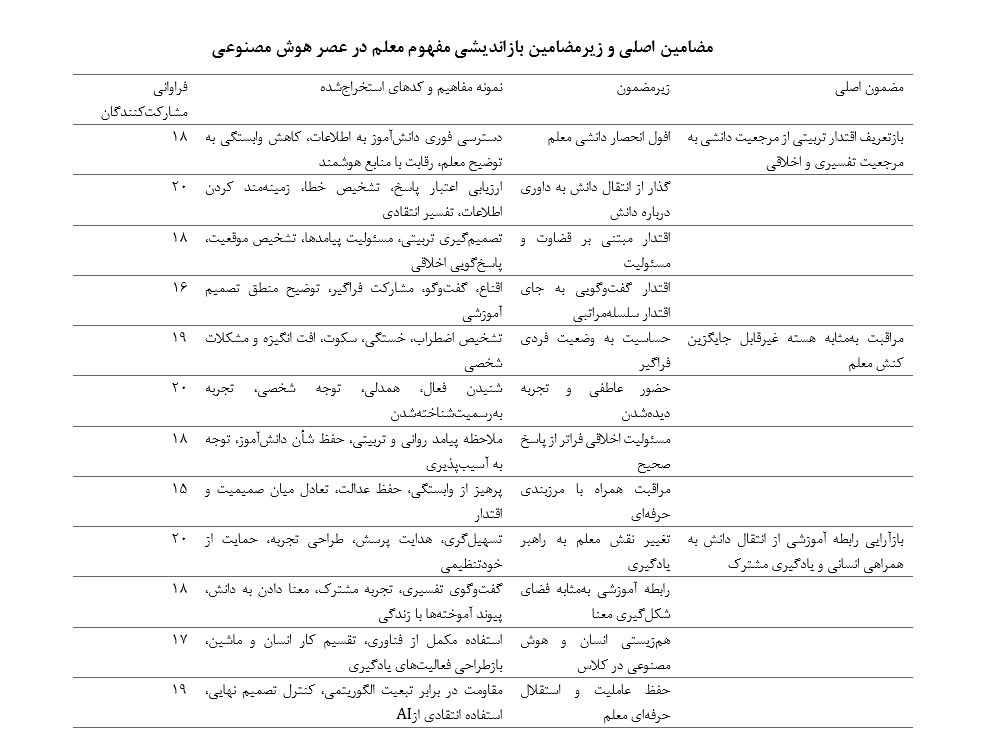
This study aimed to philosophically and educationally rethink the concept of the teacher in the age of artificial intelligence by examining how educational authority, care, and the educational relationship are being redefined in AI-mediated educational environments. This qualitative study employed an interpretive orientation and reflective thematic analysis. The participants were 20 teachers, school principals and educational deputies, university faculty members in education, teacher educators, and specialists in educational technology and artificial intelligence in Tehran, selected through purposive maximum-variation sampling. Data were collected through in-depth semi-structured interviews, and sampling continued until conceptual saturation was achieved. All interviews were audio-recorded, transcribed verbatim, and analyzed concurrently with data collection. Open coding, constant comparison, conceptual clustering, subtheme development, and construction of overarching themes were conducted using MAXQDA 2024. Credibility and analytical rigor were enhanced through participant feedback, peer review, detailed documentation of analytical decisions, and systematic comparison across interviews. The findings revealed three fundamental transformations in the concept of the teacher in the age of AI. First, educational authority shifted from knowledge monopoly toward interpretive, critical, and ethical authority grounded in judgment and responsibility. Second, care emerged as an irreducibly human and relational core of teaching, encompassing recognition, sensitivity to learners’ vulnerability, dignity, and ethical responsiveness. Third, the educational relationship was reconfigured from one-way knowledge transmission toward learning guidance, collaborative meaning-making, and human accompaniment. The findings further indicated that meaningful AI integration requires preservation of teachers’ professional agency and resistance to transferring sensitive educational decisions entirely to algorithmic systems. Artificial intelligence does not eliminate the need for teachers; rather, it intensifies the need to redefine their role. The distinctive educational value of teachers increasingly lies in ethical judgment, contextual interpretation, care, professional responsibility, and the capacity to create meaningful human relationships through which learning, agency, and personal development can occur.
Downloads
References
1. Wojciechowski A, Korjonen‐Kuusipuro K. How Artificial Intelligence Affects Education? Human Technology. 2023;19(3):302-6. doi: 10.14254/1795-6889.2023.19-3.0.
2. Zhou J, Zhang J, Li H. Exploring the Use of Artificial Intelligence in Teaching Management and Evaluation Based on Citation Space Analysis. Journal of Education and Educational Research. 2023;3(2):42-5. doi: 10.54097/jeer.v3i2.9014.
3. Li WX. The Influence of Artificial Intelligence on the Education System. Lecture Notes in Education Psychology and Public Media. 2024;65(1):137-42. doi: 10.54254/2753-7048/65/20240158.
4. Agostini D, Picasso F. Large Language Models for Sustainable Assessment and Feedback in Higher Education. Intelligenza Artificiale. 2024;18(1):121-38. doi: 10.3233/ia-240033.
5. Abdekhoda M, Dehnad A. Adopting Artificial Intelligence Driven Technology in Medical Education. Interactive Technology and Smart Education. 2024;21(4):535-45. doi: 10.1108/itse-12-2023-0240.
6. Al-Mousa s, Asiri H, Alshammri N. Integration of Artificial Intelligence in STEM Education to Enhance Problem Solving and Critical Thinking Skills. 2026. doi: 10.21203/rs.3.rs-10195882/v1.
7. Luketić D, Diković M. Individualized Teaching and Personalized Learning in Higher Education: Insights and Future Directions From Systematic Mapping Review. Trends in Higher Education. 2026;5(2):45. doi: 10.3390/higheredu5020045.
8. Alammari A. Evaluating Generative AI Integration in Saudi Arabian Education: A Mixed-Methods Study. Peerj Computer Science. 2024;10:e1879. doi: 10.7717/peerj-cs.1879.
9. Nadjiba M, Belmekki A. Striking the Balance of AI Use in EFL Education: Maximizing Benefits, and Minimizing Risks. Atras Journal. 2024;5(3):69-79. doi: 10.70091/atras/ai.4.
10. Shahzad MF, Xu S, An X, Asif M. Are Generative AI Technologies Transforming Education for the 21st Century? Research Trends, Challenges, and Benefits. Sage Open. 2025;15(3). doi: 10.1177/21582440251368594.
11. Tashtoush MA, Wardat Y, AlAli R, Saleh SG. Artificial Intelligence in Education: Mathematics Teachers’ Perspectives, Practices and Challenges. Iraqi Journal for Computer Science and Mathematics. 2024;5(1). doi: 10.52866/ijcsm.2024.05.01.004.
12. Ning Y, Zhang C, Xu B, Zhou Y, Wijaya TT. Teachers’ AI-TPACK: Exploring the Relationship Between Knowledge Elements. Sustainability. 2024;16(3):978. doi: 10.3390/su16030978.
13. Erol M, Canbeldek M, Erol A, Çolak FG. Exploring the Relationship Between Teachers' AI Attitudes, AI Self‐Efficacy, and AI Technological Pedagogical Content Knowledge. European Journal of Education. 2025;60(4). doi: 10.1111/ejed.70332.
14. Guo L. Is Generative Artificial Intelligence Literacy Important? A Study on the Factors Influencing Teacher’s Professional Flourishing. Frontiers in Psychology. 2026;17. doi: 10.3389/fpsyg.2026.1768712.
15. Koh J, Cowling M, Jha M, Sim KN. The Human Teacher, the AI Teacher and the AIed-Teacher Relationship. Journal of Higher Education Theory and Practice. 2023;23(17). doi: 10.33423/jhetp.v23i17.6543.
16. Gupta P, Sreelatha C, Latha AA, Raj S, Singh A. Navigating the Future of Education: The Impact of Artificial Intelligence on Teacher-Student Dynamics. Eatp. 2024:6006-13. doi: 10.53555/kuey.v30i4.2332.
17. Lai T, Xie C, Ruan M, Wang Z, Lu H, Fu S. Influence of Artificial Intelligence in Education on Adolescents’ Social Adaptability: The Mediatory Role of Social Support. Plos One. 2023;18(3):e0283170. doi: 10.1371/journal.pone.0283170.
18. Fikri Y, Rhalma M. Artificial Intelligence (AI) in Early Childhood Education (ECE): Do Effects and Interactions Matter? International Journal of Religion. 2024;5(11):7536-45. doi: 10.61707/y74fv875.
19. Altınay Z, Altınay F, Dağlı G, Shadiev R, Othman A. Factors Influencing AI Learning Motivation and Personalisation Among Pre-Service Teachers in Higher Education. Mier Journal of Educational Studies Trends & Practices. 2024:462-81. doi: 10.52634/mier/2024/v14/i2/2714.
20. Ishak I, Halimah M, Ungku Kairunnisa BTUMN. Lecturers’ Experiences in Human Expertise and Generative AI in Developing Communicative Speaking Materials for English Foreign Language (EFL). 2026. doi: 10.21203/rs.3.rs-10648030/v1.
21. Rütti-Joy O, Winder G, Biedermann H. Teacher Educator Professionalism in the Age of AI: Navigating the New Landscape of Quality Education. 2024. doi: 10.5772/intechopen.1005030.
22. Turós M, Tari IP, Szőke-Milinte E, Rubovszky R, Soltész-Várhelyi K, Zsódi V, et al. Beyond Utility: The Impact of Religiosity and Calling on AI Adoption in Education. Religions. 2025;16(8):1069. doi: 10.3390/rel16081069.
23. Osman Z, Alwi NH, Khan BNA, Jodi KHM, Ismail MN. Deciphering Academicians' Usage of Artificial Intelligence Among Academicians in Higher Education Institutions. International Journal of Academic Research in Business and Social Sciences. 2023;13(10). doi: 10.6007/ijarbss/v13-i10/18983.
24. Younas M, Menhas R, Noor U. The Role of Digital Transformation and English Language Technological Self‐Efficacy in the Era of Artificial Intelligence. European Journal of Education. 2026;61(1). doi: 10.1111/ejed.70536.
25. Huo X, Siau K. Generative Artificial Intelligence in Business Higher Education. Journal of Global Information Management. 2024;32(1):1-21. doi: 10.4018/jgim.364093.
26. Pande S, Moon JS, Haque MF. Education in the Era of Artificial Intelligence: An Evidence From Dhaka International University (Diu). Bangladesh Journal of Multidisciplinary Scientific Research. 2024;9(1):7-14. doi: 10.46281/bjmsr.v9i1.2186.
27. Easouh FYJ, Oweis TE, Makahleh HA. A Bibliometric Lens on the Future: How AI Continues to Transform Education Institutions. Human Systems Management. 2024;43(6):825-44. doi: 10.3233/hsm-240005.
28. Altınay Z, Altınay F, Sharma RC, Dağlı G, Shadiev R, Yıkıcı B, et al. Capacity Building for Student Teachers in Learning, Teaching Artificial Intelligence for Quality of Education. Societies. 2024;14(8):148. doi: 10.3390/soc14080148.
29. Felizarte M, Camaso SM, Napuar JG, Padrones S, Oficiar JRG, Molina J. Social Media and Ai Integration Into Teaching and Learning Experience. Studies in Technology and Education. 2024;3(1):12-25. doi: 10.55687/ste.v2i2.63.
30. Zha H, Li W, Wang W, Jian X. The Paradox of AI Empowerment in Primary School Physical Education: Why Technology May Hinder, Not Help, Teaching Efficiency. Behavioral Sciences. 2025;15(2):240. doi: 10.3390/bs15020240.
31. Waleed M, Eman, Bashir F, Nasim I. Artificial Intelligence Revolution: Shaping the Future of Millennials. Pakistan Journal of Humanities and Social Sciences. 2023;11(4). doi: 10.52131/pjhss.2023.1104.0689.
32. Arruda EP, Arruda DEP. Artificial Intelligence for SDG 4 of the 2030 Agenda: Transforming Education to Achieve Quality, Equality, and Inclusion. Sustainable Economies. 2024;2(2):34. doi: 10.62617/se.v2i2.34.
33. Lišnić B, Zaharija G, Mladenović S. Integration of Artificial Intelligence in K-12: Analysis of a Three-Year Pilot Study. Ai. 2025;6(3):49. doi: 10.3390/ai6030049.
Downloads
Publication Timeline
- Submitted
- Revised
- Accepted
Issue
Section
License
Copyright (c) 2025 Masumeh Bayat (Corresponding author)

This work is licensed under a Creative Commons Attribution-NonCommercial 4.0 International License.