The Effect of Digital Literacy on Perceived Interactivity in Learner–Artificial Intelligence Interaction: The Mediating Roles of Self-Efficacy in Web Information Retrieval and Human–Robot Interaction
Keywords:
Digital Literacy, Perceived Interactivity, Learner–Artificial Intelligence Interaction, Web Information Retrieval Self-Efficacy, Human–Robot Interaction Self-EfficacyAbstract
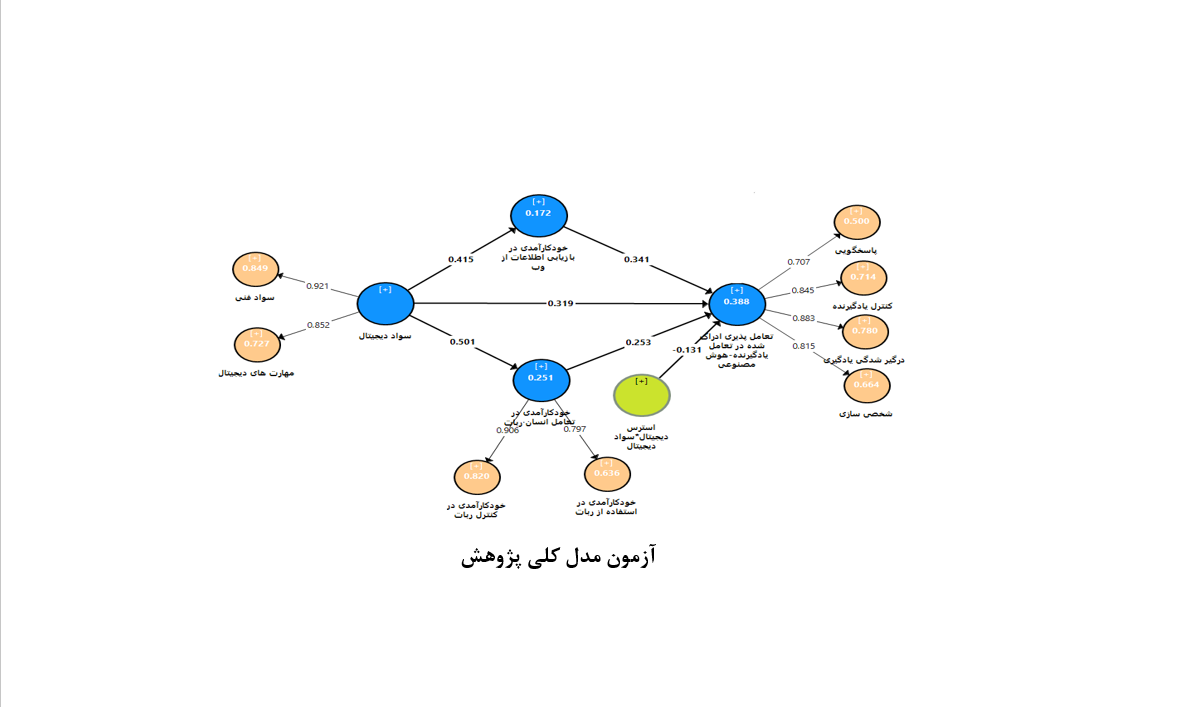
This study aimed to examine the effect of digital literacy on perceived interactivity in learner–artificial intelligence interaction, with particular emphasis on the mediating roles of self-efficacy in web information retrieval and self-efficacy in human–robot interaction. This applied study employed a descriptive-survey design. The statistical population comprised all elementary school teachers in Rudsar, Iran, from whom 234 participants were selected based on the Krejcie and Morgan sample-size table using stratified random sampling. Data were collected using the standardized questionnaire developed by Ren et al. (2025), which assessed digital literacy, perceived interactivity in learner–AI interaction, self-efficacy in web information retrieval, and self-efficacy in human–robot interaction. Instrument reliability and validity were evaluated using Cronbach’s alpha, composite reliability, and average variance extracted, all of which met acceptable criteria. Data were analyzed using SPSS and SmartPLS through partial least squares structural equation modeling (PLS-SEM). Digital literacy had significant positive effects on self-efficacy in web information retrieval (β=0.415, t=7.627), perceived interactivity in learner–AI interaction (β=0.319, t=5.135), and self-efficacy in human–robot interaction (β=0.501, t=9.705). Self-efficacy in web information retrieval (β=0.341, t=4.473) and self-efficacy in human–robot interaction (β=0.253, t=3.775) also significantly and positively affected perceived interactivity. Bootstrap analysis further demonstrated significant indirect effects of digital literacy on perceived interactivity through self-efficacy in web information retrieval (β=0.142, t=3.051, p<0.001) and self-efficacy in human–robot interaction (β=0.127, t=2.497, p=0.003), confirming both mediating pathways. Digital literacy enhances teachers’ perceived interactivity with artificial intelligence both directly and indirectly by strengthening their confidence in retrieving and evaluating web-based information and interacting effectively with intelligent systems. Accordingly, teacher development programs should integrate digital literacy training with strategies designed to strengthen information-retrieval competence and self-efficacy in interactions with AI-based technologies.
Downloads
References
1. Ifenthaler D, Schumacher C. Reciprocal issues of artificial and human intelligence in education. Journal of Research on Technology in Education. 2023;55:1-6. doi: 10.1080/15391523.2022.2154511.
2. Kasneci E, Sessler K, Küchemann S, Bannert M, Dementieva D, Fischer F. ChatGPT for good? On opportunities and challenges of large language models for education. Learning and Individual Differences. 2023;103:102274. doi: 10.1016/j.lindif.2023.102274.
3. Bhullar PS, Joshi M, Chugh R. ChatGPT in higher education—a synthesis of the literature and a future research agenda. Education and Information Technologies. 2024;29:21501-22. doi: 10.1007/s10639-024-12723-x.
4. Shao Z, Chen K. Understanding individuals' engagement and continuance intention of MOOCs: The effect of interactivity and the role of gender. Internet Research. 2021;31:1262-89. doi: 10.1108/INTR-10-2019-0416.
5. Walter Y. Embracing the future of artificial intelligence in the classroom: The relevance of AI literacy, prompt engineering, and critical thinking in modern education. International Journal of Educational Technology in Higher Education. 2024;21:15. doi: 10.1186/s41239-024-00448-3.
6. Yaseen H, Mohammad AS, Ashal N, Abusaimeh H, Ali A, Sharabati AAA. The impact of adaptive learning technologies, personalized feedback, and interactive AI tools on student engagement: The moderating role of digital literacy. Sustainability. 2025;17(3):1133. doi: 10.3390/su17031133.
7. Haroud S, Saqri N. Generative AI in higher education: Teachers' and students' perspectives on support, replacement, and digital literacy. Education Sciences. 2025;15:396. doi: 10.3390/educsci15040396.
8. Khadivi A, Parvinzadeh M, Arefnezhad S. The mediating role of digital skills in the relationship between artificial intelligence literacy and educational service quality: A case study of Farhangian University. Scholarship Studies. 2025;4(3):1-16.
9. Hosseini N. Explaining the role of artificial intelligence literacy in strengthening higher-order thinking skills among student teachers: The mediating roles of behavioral engagement and peer interaction. Technology and Scholarship in Education. 2025;5(2):55-75.
10. Faraghat L, Abdolmohammad Baghani A, Beyki N, Moradgholi M, Gharabaghi B. The relationship between digital literacy and academic self-efficacy. First International Conference on New Scientific and Research Achievements in Education and Humanities with an Educational, Religious, and Cultural Pathology Approach in Iran and the World; Bushehr, Iran2025. p. 1-20.
11. Mehrafzoun D, Najafi S. The relationship of digital literacy, academic self-efficacy, and social support with academic adjustment among secondary school students. Research in Educational Issues. 2025;1(74):1-10.
12. Hajizadeh A, Hassani M, Shirbagi N. Artificial intelligence, digital literacy, and academic entrepreneurship: Examining the role of self-efficacy and social support. Iranian Journal of Engineering Education. 2025;28(107):1-15.
13. Rodon C, Chevalier A. Toward more comprehensive Chinese internet users' studies: Translation and validation of the Chinese-Mandarin version of the 8-item information retrieval on the web self-efficacy scale (Ch-IROWSE). International Journal of Human-Computer Interaction. 2017;33:846-55. doi: 10.1080/10447318.2017.1294335.
14. Soheili F, Abdi A, Khanchehzar T. The mediating role of internet self-efficacy in the relationship between digital competence and professional development. Scholarship Studies. 2024;3(1):21-39.
15. Fan S, Yu Z, Zheng X, Gao C. Relationship between psychological adaptability and work engagement of college teachers within smart teaching environments: The mediating role of digital information literacy self-efficacy. Frontiers in Psychology. 2023;14:1057158. doi: 10.3389/fpsyg.2023.1057158.
16. Ren J, Guo J, Li H. Linking digital competence, self-efficacy, and digital stress to perceived interactivity in AI-supported learning contexts. Scientific Reports. 2025;15(1):33182. doi: 10.1038/s41598-025-18873-3.
Downloads
Publication Timeline
- Submitted
- Revised
- Accepted
Issue
Section
License
Copyright (c) 2025 Mohamad Porfarzollah (Author); Samira Pali (Corresponding author)

This work is licensed under a Creative Commons Attribution-NonCommercial 4.0 International License.