Theatre: An Audience Attraction Model in Performing Arts Based on Cultural Needs Assessment
DOI:
https://doi.org/10.61838/jsied.491Keywords:
Audience Attraction, Performing Arts, Theatre, Cultural Needs Assessment, Cultural Marketing, Social Participation, Structural Equation ModelingAbstract
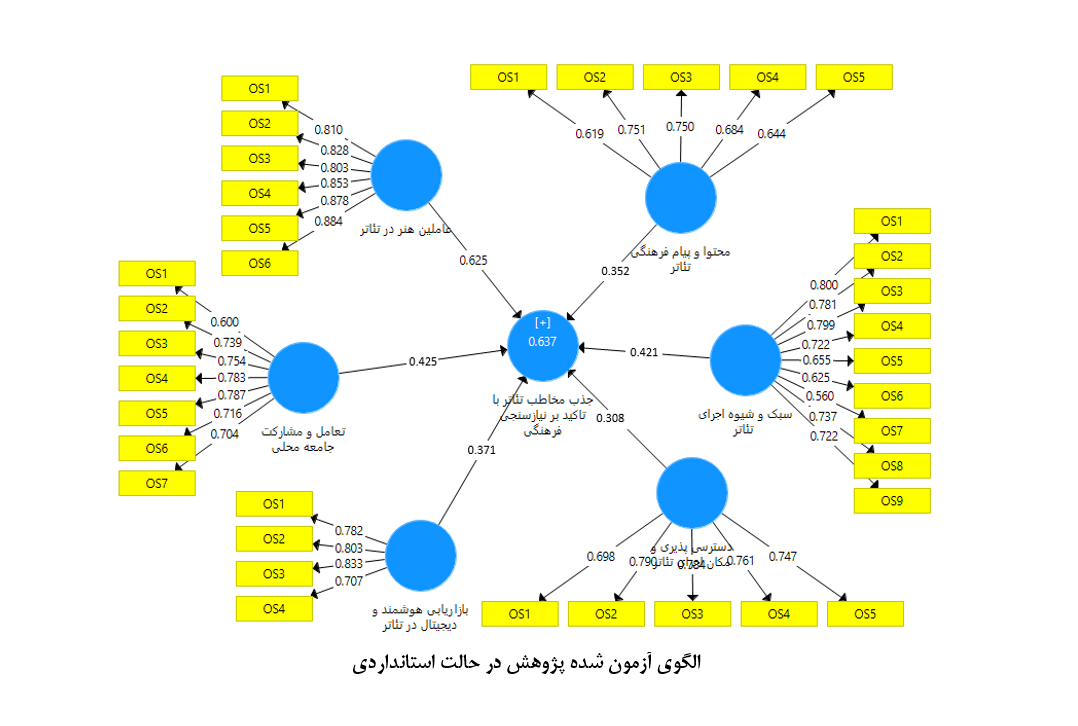
The present study aimed to design and validate a theatre audience attraction model based on cultural needs assessment and to examine the influence of cultural, artistic, social, and communication-related factors on attracting performing arts audiences. This applied study employed a descriptive–analytical design. The statistical population included theatre audiences, performing arts enthusiasts, regular and irregular spectators, as well as managers and staff of cultural institutions in Kermanshah Province. Based on the Morgan table, 384 participants were selected through stratified random sampling. Data were collected using a researcher-made questionnaire developed from the qualitative phase of the study, consisting of six dimensions, 35 components, and 140 indicators. The validity of the instrument was confirmed through face validity, content validity, and confirmatory factor analysis, while reliability was verified using Cronbach’s alpha coefficient. Data were analyzed using SPSS and SmartPLS through structural equation modeling and the partial least squares method. The results demonstrated that the proposed model had satisfactory fit, with a goodness-of-fit index of 0.63. The dependent variable, “theatre audience attraction based on cultural needs assessment,” yielded an R² value of 0.637, indicating that approximately 63.7% of the variance in audience attraction was explained by the model variables. Among the research components, “theatre artistic agents” showed the strongest effect on audience attraction (β=0.62). “Community interaction and participation” and “style and method of theatrical performance” ranked next (β=0.42 each). In addition, “smart and media-based marketing” (β=0.37), “cultural content and message” (β=0.35), and “accessibility and performance venue” (β=0.30) had significant positive effects (P<0.01). The findings indicated that theatre audience attraction is a multidimensional process in which artistic quality, social participation, innovative performance methods, and cultural alignment play essential roles. The findings revealed that theatre audience attraction in Kermanshah is primarily influenced by the quality of artistic elements and the extent to which theatrical productions are connected to the cultural and social identity of audiences. The more theatrical works reflect local cultural values and preferences while benefiting from strong artistic quality and effective media communication, the greater the likelihood of sustainable audience development. Therefore, cultural policymaking in the field of performing arts should focus on strengthening professional artistic foundations, expanding social participation, and making effective use of media and communication capacities.
Downloads
References
1. Ulziibadrakh Z, Szakály Z. Market Landscape and the Role of Marketing in the Field of Mongolian Performing Arts Organizations. Anali Ekonomskog Fakulteta U Subotici. 2025(53):17-36. doi: 10.5937/aneksub2400001u.
2. Alnasser NS, Lim JY. Strategies Applied by Different Arts and Cultural Organizations for Their Audience Development: A Comparative Review. Heliyon. 2023;9(5):e15835. doi: 10.1016/j.heliyon.2023.e15835.
3. Jiang S, Kinney M, Yost C. Architecture Matters: Exploring Audiences’ Holistic Theatrical Experience Through Social Media Reviews. Arts and the Market. 2024;14(2/3):129-49. doi: 10.1108/aam-09-2023-0065.
4. Baldin A, Bille T, Mukkamala RR, Vatrapu R. The Impact of Social Media Activities on Theater Demand. Journal of Cultural Economics. 2023;48(2):199-220. doi: 10.1007/s10824-023-09480-z.
5. Xu Y. Social Media Marketing Strategy in Chinese Musical Theatre Industry. Communication Society and Media. 2023;6(4):p15. doi: 10.22158/csm.v6n4p15.
6. Li A. Application of Virtual Reality in the Inheritance of Peking Opera. Frontiers in Art Research. 2023;5(3). doi: 10.25236/far.2023.050312.
7. Wei S. Critical Assessment of the Impacts of Digital Technological Developments on Opera Companies and Consumers Through Production and Consumption. Media and Communication Research. 2023;4(10). doi: 10.23977/mediacr.2023.041003.
8. Zoljargal U. The Impact of Covid-19 Pandemic on the Marketing of the Performing Arts. Oradea Journal of Business and Economics. 2022;7(Special):120-30. doi: 10.47535/1991ojbe151.
9. Gryllakis N, Matsiola M. Digital Audiovisual Content in Marketing and Distributing Cultural Products During the COVID-19 Pandemic in Greece. Arts and the Market. 2022;13(1):4-19. doi: 10.1108/aam-09-2021-0053.
10. Hattingh C, Niekerk A. ‘Different Strokes for Different Folks’: Segmenting Drag Cabaret Audiences in South Africa. International Conference on Tourism Research. 2022;15(1):598-607. doi: 10.34190/ictr.15.1.154.
11. Timčíková Z. Current Starting Points to Audience Development in Slovak Theatres. Slovenske Divadlo /the Slovak Theatre. 2022;70(3):282-95. doi: 10.31577/sd-2022-0019.
12. Wang MZ. Economic Performance and Business Models in the Chinese Theatre Industry: A Comparison of Wuzhen Water Town and Huichang Theatre Village. Advances in Economics Management and Political Sciences. 2024;110(1):93-9. doi: 10.54254/2754-1169/110/2024ed0137.
13. Yilmaz KÇ. The Theatre of Martin Crimp as a Critique of Urban Consumer Society. Kent Akademisi. 2023;16(2):1297-309. doi: 10.35674/kent.1117132.
14. Xiang S. The Discussing of the Development History and Existing Problems of Immersive Theater in China. 2022:709-14. doi: 10.2991/978-2-494069-05-3_86.
15. Olanrewaju AS. Challenges of the Creative Industries in Nigeria: A Case Study of the Performing Arts Industry. British Journal of Mass Communication and Media Research. 2024;4(2):1-17. doi: 10.52589/bjmcmr-rzvlsbmh.
16. Radigales J, Villanueva-Benito I. Technology, Audio-Visual Adaptation and Cultural Re-Education of Opera. Tripodos. 2022(51):131-42. doi: 10.51698/tripodos.2021.51p131-142.
17. Shum HH. Oculus Power! Arts and Technology’s Mediation of Postcolonial Neoliberal Nationalism in Hong Kong. Global Media and China. 2023;9(1):84-100. doi: 10.1177/20594364231194671.
18. Ali AW, Tahir HM, Hashim H. Comparing Performing Theatres for Small and Big Scale Productions in Malaysia. International Journal of Academic Research in Accounting Finance and Management Sciences. 2023;13(1). doi: 10.6007/ijarafms/v13-i1/15357.
19. Gushiken Y. Plateia-Foyer: Diálogo E Formação De Público Na Leitura Dramatizada Em Artes Cênicas. Revista Lusófona De Estudos Culturais. 2023;10(1):113-31. doi: 10.21814/rlec.4429.
Downloads
Publication Timeline
- Submitted
- Revised
- Accepted
Issue
Section
License
Copyright (c) 2025 Pouria Jalali (Author); Rozita Sepehrnia (Corresponding author); Fatemeh Azizabadi Farahani (Author)

This work is licensed under a Creative Commons Attribution-NonCommercial 4.0 International License.