Designing a Tacit Knowledge Storage Model for Retired Employees of the Ministry of Energy through the Development of Knowledge Management with a Strategic Approach
Keywords:
Tacit knowledge storage, knowledge management, strategic approach, retirees, Ministry of EnergyAbstract
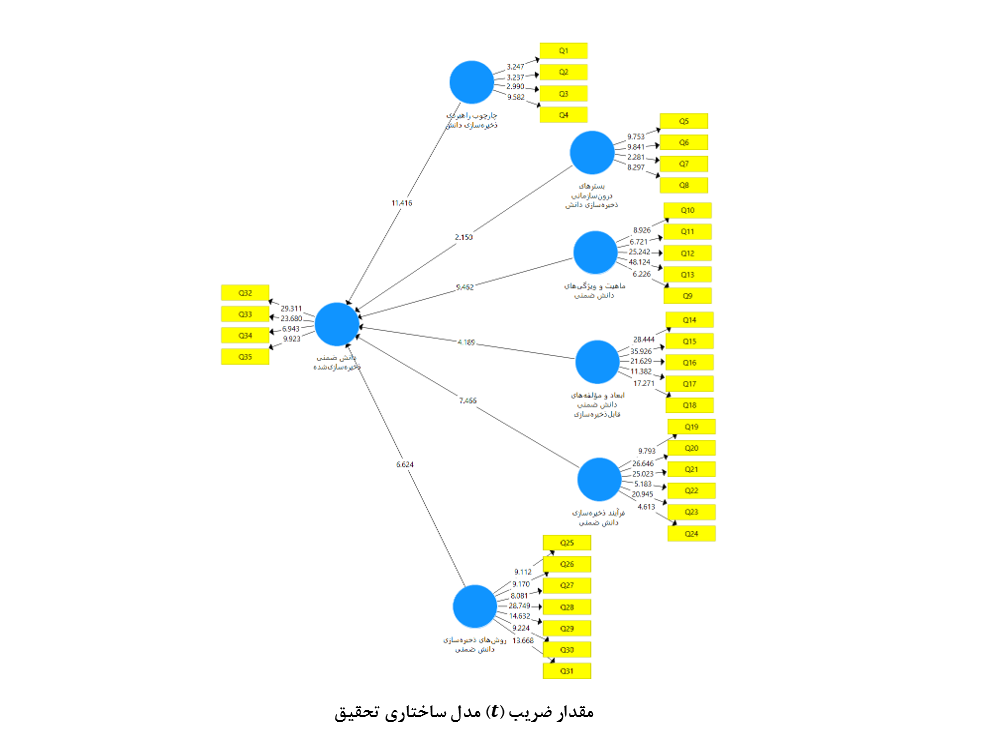
This study aimed to design and validate a strategic model for preserving the tacit knowledge of retired employees of the Ministry of Energy through knowledge management development and the prevention of organizational knowledge loss. This applied-developmental study employed a sequential exploratory mixed-methods design. In the qualitative phase, data were collected through 15 semi-structured interviews with experts, experienced employees, and retirees of the Ministry of Energy selected purposively; theoretical saturation emerged by the twelfth interview, while interviews continued through the fifteenth participant for confirmation. The data were analyzed using thematic analysis. In the quantitative phase, the statistical population consisted of 320 managers and employees with at least 10 years of service. Of 200 researcher-developed questionnaires distributed, 176 usable questionnaires were returned. The measurement model was evaluated for reliability and validity, and the structural model was analyzed using partial least squares structural equation modeling in SmartPLS. Inferential analysis demonstrated satisfactory reliability and validity of the measurement model. Cronbach’s alpha and composite reliability coefficients were within acceptable ranges, and all average variance extracted values exceeded 0.50. Discriminant validity was also confirmed using the Fornell–Larcker criterion. All item factor loadings exceeded 0.50, and their t-statistics were greater than 1.96, indicating statistically significant measurement indicators. The highest factor loading was 0.939 and belonged to an indicator of the “nature and characteristics of tacit knowledge” construct. Bootstrap analysis further indicated that all structural relationships specified in the model were statistically significant, with t-values exceeding the critical value of 1.96. The proposed model demonstrated adequate empirical validity for organizing and explaining the storage of retirees’ tacit knowledge in the Ministry of Energy. Effective preservation of this knowledge requires the coordinated integration of a strategic knowledge-storage framework, supportive organizational contexts, recognition of tacit knowledge characteristics, identification of storable knowledge, systematic storage processes, and diversified knowledge-capturing mechanisms. Implementing this model can strengthen organizational memory, reduce the loss of accumulated expertise, prevent the recurrence of past errors, and improve the quality and continuity of strategic decision-making.
Downloads
References
1. Bazrkar A, Haji Mohammadi M. The Effect of Knowledge Management on Organizational Financial Performance Considering the Mediating Role of Innovation and Organizational Intelligence. Modern Research Approaches in Management and Accounting. 2019;5(26).
2. Mehrabi N, Soleimani B, Eskandari F. Designing a Knowledge Management Framework for Business Sustainability and Long-Term Development Using the Delphi Technique. Strategic Management of Organizational Knowledge. 2025;8(31).
3. Polanyi M. The Tacit Dimension. Garden City, NY: Doubleday & Company; 1966.
4. Nonaka I, Takeuchi H. The Knowledge-Creating Company: How Japanese Companies Create the Dynamics of Innovation: Oxford University Press; 1995.
5. Adesina AO, Ocholla DN. Tacit Knowledge Management Strategies of Small- and Medium-Sized Enterprises: An Overview. South African Journal of Information Management. 2024;26(1):1711. doi: 10.4102/SAJIM.v26i1.1711.
6. Wang S, Noe RA. Knowledge Sharing: A Review and Directions for Future Research. Human Resource Management Review. 2010;20(2):115-31. doi: 10.1016/j.hrmr.2009.10.001.
7. Yıldız T, Balkan Akan B, Sığrı Ü, Dabić M. Impact of Knowledge-Sharing Culture on Organizational Creativity: Integrating Explicit and Tacit Knowledge Sharing as Mediators. Journal of Knowledge Management. 2025;29(4):1248-77. doi: 10.1108/JKM-05-2024-0633.
8. Dash S, Singh HK, Singh S. Hoard before You Share: Knowledge Hoarding as Mediator between Meaningful Work and Tacit Knowledge Sharing. Knowledge Management Research & Practice. 2026:1-14. doi: 10.1080/14778238.2026.2631090.
9. Duan Z. Digitalization of Artisans' Tacit Knowledge: A 3D Modeling-Based Knowledge Management Framework for Intangible Handicraft Brand Design. International Journal of Knowledge Management (IJKM). 2026;22(1):1-17. doi: 10.4018/IJKM.411887.
10. Masri R, Umaira F, Yunos SN, Vui CN. Tacit Knowledge Sharing of ICT Technopreneurs: Integration of Individual, Organizational, and Technological Factors. Cham: Springer Nature Switzerland; 2026. p. 489-98.
11. Wu C, Hu X, Guo X, Ning X, Hui C. Fragile Interpersonal Relationship in Tacit Knowledge Sharing: How Workplace Friendship Fails under Competition and Functional Similarity. Production and Operations Management. 2026;35(3):1038-55. doi: 10.1177/10591478251364591.
12. Haug A. Critical Success Factors for Knowledge Management Systems in New Product Development. Knowledge Management Research & Practice. 2026;24(1):1-13. doi: 10.1080/14778238.2024.2424290.
13. Wang RC, Hsieh MC, Lai LC. From Tacit Knowledge Distillation to AI-Enabled Culture Revitalization: Modeling Knowledge Cycles in Indigenous Cultural Systems. Social Sciences. 2025;15(1):7. doi: 10.3390/socsci15010007.
14. Moghadam A, Jomeh V, Mesri M. Developing a Model for Improving Electronic Service Processes Based on Social Participation and Knowledge Accumulation. Information Management Sciences and Techniques. 2026.
15. Mohaghar A, Maleki MH, Seyed Mirzaei M. A Framework for Risk Management of Petrochemical Industry Development Projects with Emphasis on Knowledge Management Capabilities. Management Improvement. 2025;19(3).
16. Kotbi F, Tolabi Mazraeh Now A, Naghlilou Z. The Effect of Explicit and Tacit Knowledge Sharing on the Performance of the General Directorate of Sports and Youth of Yazd Province with the Mediating Role of Service Innovation. Applied Research in Sport Management. 2025;14(3).
17. Shafiei Nikabadi M, Moghadam A, Mirhosseini V, Daraei M. Designing a Digital Open Innovation Ecosystem in the Context of Knowledge Management in Knowledge-Based Companies. Industrial Management Perspective. 2025;15(58).
18. Fredberg T, Pregmark JE. Organizational Transformation: Handling the Double-Edged Sword of Urgency. Long Range Planning. 2022;55(2):102091. doi: 10.1016/j.lrp.2021.102091.
Downloads
Publication Timeline
- Submitted
- Revised
- Accepted
Issue
Section
License
Copyright (c) 2025 Ali Froughy (Author); Mohammad Saeed Bagherzade (Corresponding author); Sepideh Modanlou Joybari, Ghasemali Talebi panbeh chooleh (Author)

This work is licensed under a Creative Commons Attribution-NonCommercial 4.0 International License.