A STEAM-Based Learning Model for Fostering Innovation and Entrepreneurial Creativity among Lower Secondary School Students
Keywords:
STEAM-based learning, Innovation, Entrepreneurial creativity, Lower secondary school studentsAbstract
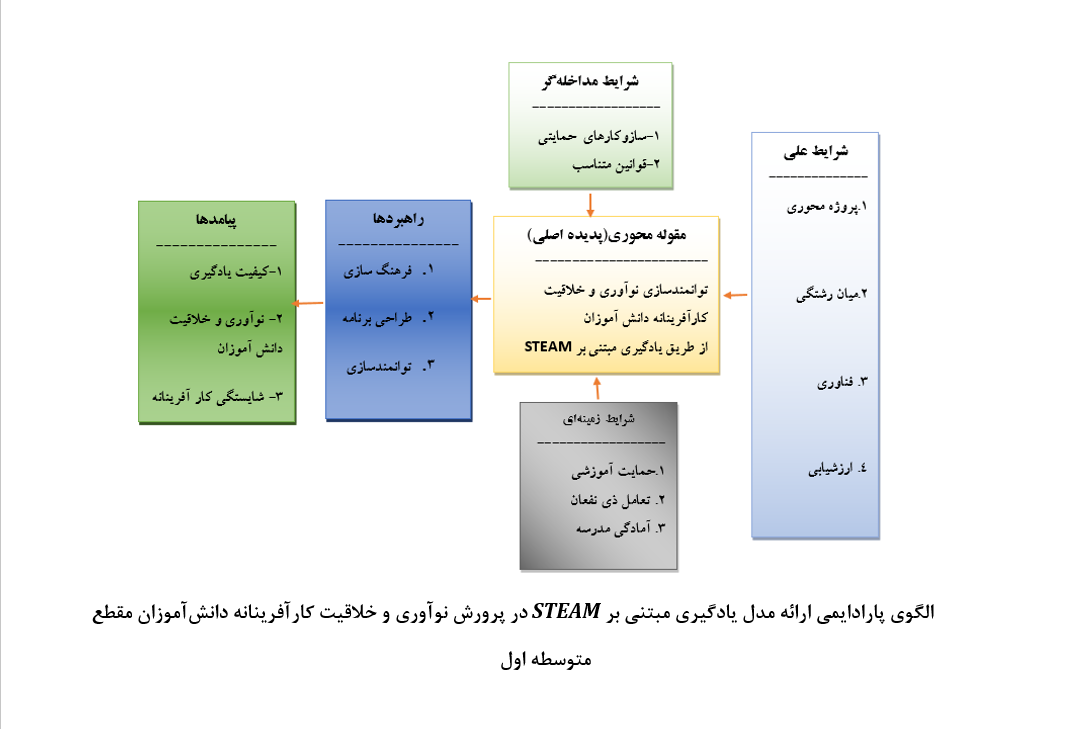
This study aimed to develop and explain a STEAM-based learning model for fostering innovation and entrepreneurial creativity among lower secondary school students. This applied qualitative study employed a grounded theory approach. The study population comprised lower secondary school administrators, experts in educational management and entrepreneurship, teachers, and university faculty members in Kurdistan Province. Participants were selected through purposive and snowball sampling, and semi-structured interviews were conducted with 10 participants until theoretical saturation was achieved. Data were analyzed using qualitative content analysis through open, axial, and selective coding. Member checking and review by non-participating experts were employed to enhance the credibility of the findings. Data analysis yielded 177 open codes and 49 axial codes and resulted in a paradigmatic model centered on “empowering students’ innovation and entrepreneurial creativity through STEAM-based learning.” The causal conditions comprised project-based learning and real-world problems, interdisciplinary integration, educational technologies, and process-oriented assessment. Educational support and leadership, stakeholder collaboration, and school readiness constituted the contextual conditions, while supportive and motivational mechanisms and appropriate regulations represented the intervening conditions. The principal strategies included promoting an innovative culture, designing targeted learning programs, and enhancing teachers’ and students’ knowledge and skills. These mechanisms culminated in improved learning quality, greater student innovation and creativity, and stronger entrepreneurial attitudes and competencies. STEAM-based learning can effectively foster students’ innovation and entrepreneurial creativity when interdisciplinary and problem-based learning is supported by appropriate school conditions, institutional support, teacher empowerment, and coherent cultural and instructional strategies.
Downloads
References
1. Hisrich RD, Peters MP, Shepherd DA. Entrepreneurship: McGraw-Hill Education; 2020.
2. Kuratko DF. Entrepreneurship: Theory, Process, Practice: Cengage Learning; 2020.
3. Rodrigues-Silva J, Alsina Á. Conceptualising and Framing STEAM Education: What Is (and What Is Not) This Educational Approach? Texto Livre. 2023;16. doi: 10.1590/1983-3652.2023.44946.
4. García Fuentes O, Raposo Rivas M, Martínez Figueira ME. STEAM Education: Review of Literature. Revista Complutense de Educación. 2023;34(1):191-202. doi: 10.5209/rced.77261.
5. Aguilera D, Ortiz-Revilla J. STEM vs. STEAM Education and Student Creativity: A Systematic Literature Review. Education Sciences. 2021;11(7):331. doi: 10.3390/educsci11070331.
6. Beghetto RA. The New Science of Teaching for Creativity: Palgrave Macmillan; 2021.
7. Razzouk R, Shute V. What Is Design Thinking and Why Is It Important? Review of Educational Research. 2016;82(3):330-48.
8. Henriksen D. Creating STEAM with Design Thinking: Beyond STEM and Arts Integration. The STEAM Journal. 2017;3(1):11.
9. Henriksen D. Design Thinking, Creativity, and STEAM Education: Routledge; 2020.
10. Herro D, Quigley C, Andrews J, Delacruz G. Co-Measure: Developing an Assessment for Student Collaboration in STEAM Activities. International Journal of STEM Education. 2019;6(1):26. doi: 10.1186/s40594-019-0174-z.
11. Hosseinnezhad H, Gheibi R, Aboozari Khoei F, Mardanlou L, Shakouri R, editors. Teaching Entrepreneurship Skills and Responsibility through Classroom Projects2026: Civilica.
12. Leavy A, Dick L, Meletiou-Mavrotheris M, Paparistodemou E, Stylianou E. The Prevalence and Use of Emerging Technologies in STEAM Education: A Systematic Review of the Literature. Journal of Computer Assisted Learning. 2023;39(4):1061-82. doi: 10.1111/jcal.12806.
13. Mahmoudi F, Adib Y, Hosseinzadeh Nabati M. The Relationship between Attitude toward the Work and Technology Course and Technological and Entrepreneurial Attitudes of Secondary School Students in District One of Tabriz. Educational Technology (Technology and Education). 2021;15(2):305-19.
14. Perignat E, Katz-Buonincontro J. STEAM in Practice and Research: An Integrative Literature Review. Thinking Skills and Creativity. 2019;31:31-43. doi: 10.1016/j.tsc.2018.10.002.
15. Yim IHY, Su J, Wegerif R. STEAM in Practice and Research in Primary Schools: A Systematic Literature Review. Research in Science & Technological Education. 2025;43(4):1065-89. doi: 10.1080/02635143.2024.2440424.
16. Ghofrani N, Hosseini SR, Mousakhani M. Designing an Entrepreneurial School Model Based on the Development of Entrepreneurial Competencies at the Secondary Level. Entrepreneurship Development. 2022;15(1):141-60.
17. Cheraghi Z, Ahmadi P, Samadi P. Designing an Entrepreneurship Curriculum Framework Based on an Integrated STEAM Approach for Upper Primary Education. Curriculum Research. 2025;15(1):183-202. doi: 10.22099/jcr.2025.8278.
Downloads
Publication Timeline
- Submitted
- Revised
- Accepted
Issue
Section
License
Copyright (c) 2025 Amir Khaledian (Corresponding author); Hamed Fazeli Kebriya (Author)

This work is licensed under a Creative Commons Attribution-NonCommercial 4.0 International License.