Determining the Relationships Among the Main Factors of the Employee Resilience Model with the Approach of Promoting Resilience in Crisis Situations Among Employees of the Education Organization of Semnan Province
Keywords:
Employee Resilience, Organizational Resilience, Crisis Situations, Education Organization, Structural Equation Modeling, Crisis ManagementAbstract
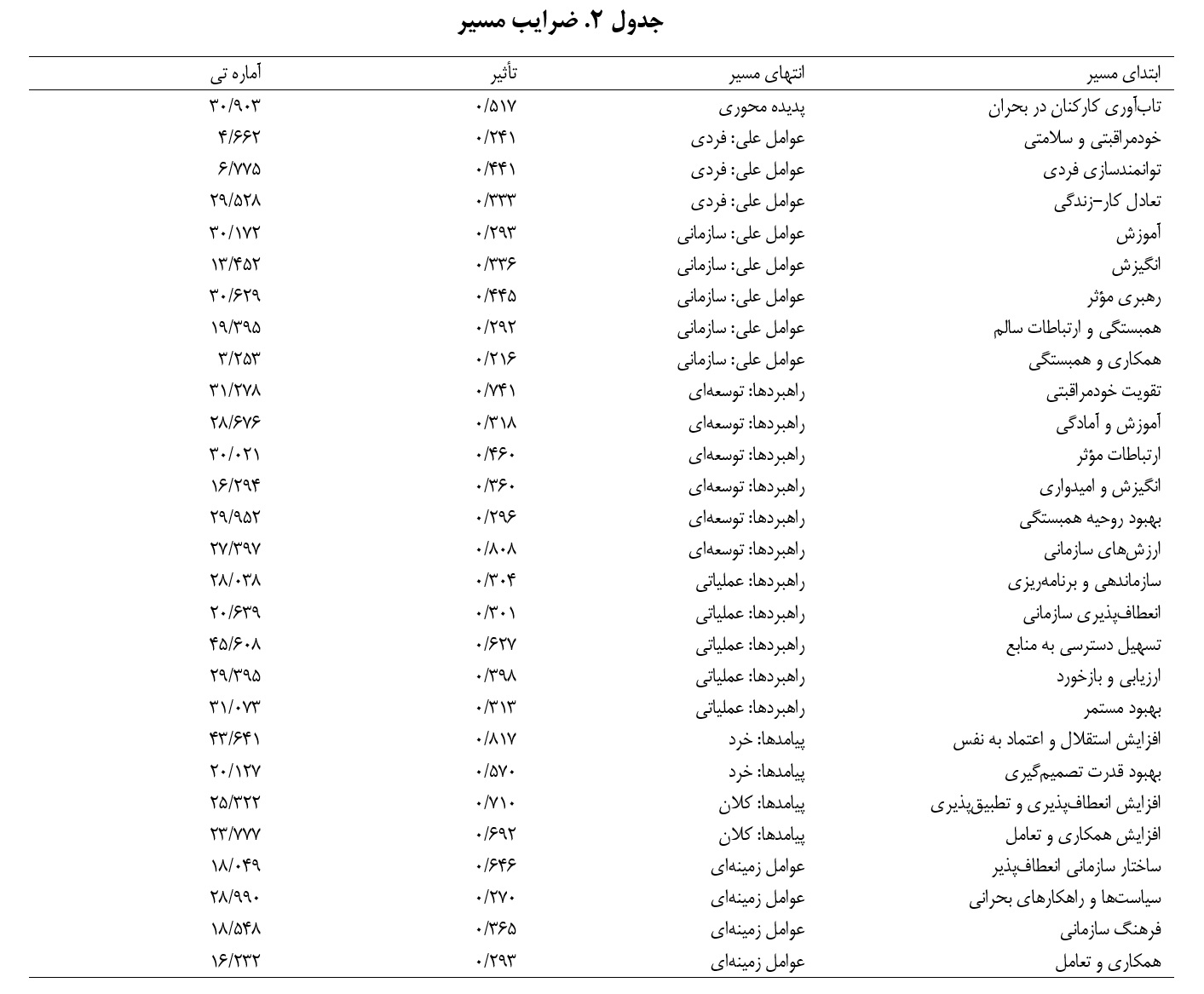
The present study aimed to determine the relationships among the main factors of the employee resilience model with the approach of promoting resilience in crisis situations among employees of the Education Organization of Semnan Province and to explain how causal, contextual, intervening, strategic, and outcome-related factors interact in shaping employee resilience. This applied study employed a descriptive-correlational design using structural equation modeling. The statistical population consisted of teachers and managers of the Education Organization of Semnan Province, from whom 220 participants were selected through simple random sampling based on Cochran’s formula. Data were collected using a researcher-developed questionnaire containing 74 items across 37 constructs and were analyzed using SPSS and Smart PLS software. Partial least squares structural equation modeling and bootstrapping techniques were used to evaluate the measurement and structural models, while path significance was assessed through t-statistics. The results indicated that all relationships among the main model factors were statistically significant (t > 1.96). Among individual causal factors, individual empowerment (β = 0.441) showed the strongest effect, while effective leadership (β = 0.445) was the most influential organizational causal factor. Organizational values (β = 0.808) and strengthening self-care (β = 0.741) emerged as the most important developmental strategies. Facilitating access to resources (β = 0.627) was the strongest operational strategy. Furthermore, training and awareness (β = 0.817), experience and learning (β = 0.710), psychological support (β = 1.027), training and development (β = 0.933), and the reward and incentive system (β = 0.839) were identified as the most influential contextual and intervening factors. The model outcomes included enhanced autonomy and self-confidence, improved decision-making ability, greater flexibility and adaptability, and increased cooperation and interaction among employees. Employee resilience in crisis situations is the product of a systematic interaction among individual, organizational, contextual, intervening, strategic, and outcome-related factors. Promoting resilience requires a comprehensive and multilevel approach that simultaneously emphasizes employee empowerment, effective leadership, organizational values, access to resources, learning and awareness, psychological support, and incentive systems. Strengthening these dimensions can enhance organizational preparedness and adaptability in the face of health, economic, and security crises while supporting sustainable performance and effective crisis management within educational organizations.
References
1. Duchek S. Organizational Resilience: A Capability-Based Conceptualization. Business Research. 2020;13:215-46. doi: 10.1007/s40685-019-0085-7.
2. Conz E, Magnani G. A Dynamic Perspective on the Resilience of Firms: A Systematic Literature Review and a Framework for Future Research. European Management Journal. 2020;38(3):400-12. doi: 10.1016/j.emj.2019.12.004.
3. Hillmann J, Guenther E. Organizational Resilience: A Valuable Construct for Management Research? International Journal of Management Reviews. 2021;23(1):7-44. doi: 10.1111/ijmr.12239.
4. Liu Y, Chen R, Zhou F, Zhang S, Wang J. Analysis of the Influencing Factors of Organizational Resilience in the ISM Framework: An Exploratory Study Based on Multiple Cases. Sustainability. 2021;13(23):13492. doi: 10.3390/su132313492.
5. Kim Y. Organizational Resilience and Employee Work-Role Performance after a Crisis Situation: Exploring the Effects of Organizational Resilience on Internal Crisis Communication. Journal of Public Relations Research. 2020;32(1-2):47-75. doi: 10.1080/1062726X.2020.1765368.
6. Ojo AO, Fawehinmi O, Yusliza MY. Examining the Predictors of Resilience and Work Engagement during the COVID-19 Pandemic. Sustainability. 2021;13(5):2902. doi: 10.3390/su13052902.
7. Bakker AB, Demerouti E, Sanz-Vergel AI. Job Demands-Resources Theory: Ten Years Later. Annual Review of Organizational Psychology and Organizational Behavior. 2023;10:25-53. doi: 10.1146/annurev-orgpsych-120920-053933.
8. Rehman KU, Mata MN, Martins JM, Mariam S, Rita JX, Correia AB. SHRM Practices Employee and Organizational Resilient Behavior: Implications for Open Innovation. Journal of Open Innovation: Technology, Market, and Complexity. 2021;7(2):159. doi: 10.3390/joitmc7020159.
9. Yu J, Yuan L, Han G, Li H, Li P. A Study of the Impact of Strategic Human Resource Management on Organizational Resilience. Behavioral Sciences. 2022;12(12):508. doi: 10.3390/bs12120508.
10. Georgescu I, Bocean CG, Vărzaru AA, Rotea CC, Mangra MG, Mangra GI. Enhancing Organizational Resilience: The Transformative Influence of Strategic Human Resource Management Practices and Organizational Culture. Sustainability. 2024;16(10):4315. doi: 10.3390/su16104315.
11. Aljuaid AA. Determining Organizational Resilience through Employee Resilient Characteristics and Supportive HR Practices: The Moderating Effect of Managerial Resilience. PLOS ONE. 2025;20(11):e0335751. doi: 10.1371/journal.pone.0335751.
12. Brown B, Wang T, Lee M, Childs A. Surviving, Navigating and Innovating through a Pandemic: A Review of Research on School Leadership during COVID-19, 2020-2021. International Journal of Educational Development. 2023;100:102804. doi: 10.1016/j.ijedudev.2023.102804.
13. Stang-Rabrig J, Brüggemann T, Lorenz R, McElvany N. Teachers' Occupational Well-Being during the COVID-19 Pandemic: The Role of Resources and Demands. Teaching and Teacher Education. 2022;117:103803. doi: 10.1016/j.tate.2022.103803.
14. Chen J, Lee JCK. Teacher Resilience Matters: A Buffering and Boosting Effect between Job Driving Factors and Their Well-Being and Job Performance. Teachers and Teaching. 2022;28(7):890-907. doi: 10.1080/13540602.2022.2116574.
15. Lu J, Chen J, Li Z, Li X. A Systematic Review of Teacher Resilience: A Perspective of the Job Demands and Resources Model. Teaching and Teacher Education. 2024;151:104742. doi: 10.1016/j.tate.2024.104742.
16. Bagdžiūnienė D, Kazlauskienė A, Nasvytienė D, Sakadolskis E. Linking Supportive School Leadership and Teacher Resilience: The Mediating Role of Job Resources. Frontiers in Education. 2022;7:999086. doi: 10.3389/feduc.2022.999086.
17. Bahadurzada HB, Edmondson AC, Kerrissey M. Psychological Safety as an Enduring Resource amid Constraints. International Journal of Public Health. 2024;69:1607332. doi: 10.3389/ijph.2024.1607332.
18. Shaya N, Abukhait R, Madani R, Khattak MN. Organizational Resilience of Higher Education Institutions: An Empirical Study during Covid-19 Pandemic. Higher Education Policy. 2023;36(3):529-55. doi: 10.1057/s41307-022-00272-2.
19. Hollands L, Haensse L, Lin-Hi N. The How and Why of Organizational Resilience: A Mixed-Methods Study on Facilitators and Consequences of Organizational Resilience throughout a Crisis. The Journal of Applied Behavioral Science. 2024;60(3):449-93. doi: 10.1177/00218863231165785.
Downloads
Publication Timeline
- Submitted
- Revised
- Accepted
Issue
Section
License
Copyright (c) 2025 محمدجواد حافظی (نویسنده); مهدی صانعی (نویسنده مسئول); سیده زهرا ساداتی, عزت اله بالوئی جامخانه, محمد حسن شکی (نویسنده)

This work is licensed under a Creative Commons Attribution-NonCommercial 4.0 International License.