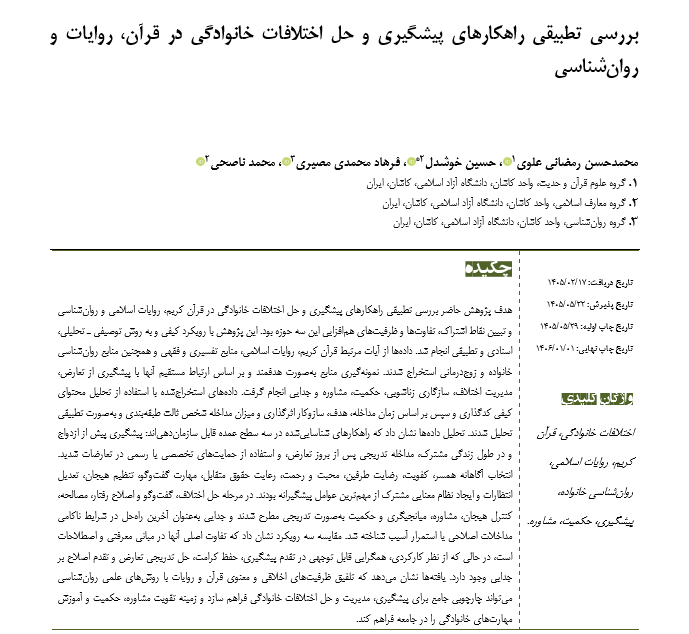
This study aimed to comparatively examine strategies for preventing and resolving family conflicts in the Holy Qur’an, Islamic narrations, and psychology and to identify their convergences, differences, and potential for integration. This qualitative study employed a descriptive-analytical, documentary, and comparative design. Data were extracted from relevant Qur’anic verses, Islamic narrations, interpretive and jurisprudential sources, and literature on family psychology and couple therapy. Sources were purposively selected according to their direct relevance to conflict prevention, marital adjustment, conflict management, arbitration, counseling, and separation. Extracted data were coded using qualitative content analysis and were subsequently categorized according to the timing of intervention, intended objective, mechanism of action, and degree of third-party involvement. A comparative analysis was then conducted across the three perspectives. The analysis indicated that the identified strategies could be organized into three major levels: prevention before marriage and throughout marital life, gradual intervention after conflict emerges, and specialized or formal intervention in severe disputes. Informed spouse selection, compatibility, mutual consent, affection and mercy, observance of reciprocal rights, constructive communication, emotional regulation, modification of expectations, and development of shared meaning emerged as major preventive factors. After conflict occurred, constructive dialogue, behavioral correction, reconciliation, emotional regulation, counseling, mediation, and family arbitration formed a gradual intervention sequence. Separation was identified as a final option when corrective interventions failed or when continuation of the relationship resulted in persistent harm. Comparative analysis showed that the primary differences among the three perspectives concerned their epistemological foundations and terminology, whereas substantial functional convergence existed regarding prevention, protection of dignity, gradual conflict resolution, third-party assistance, and prioritization of reconciliation over separation. Integrating the ethical and spiritual capacities of Qur’anic and narrative teachings with scientific psychological methods can provide a comprehensive framework for preventing, managing, and resolving family conflicts and can strengthen family counseling, arbitration, and family-skills education.








 Director in Charge